Friday, October 17, 2014

2014 Milwaukee Film Festival

Movies That I Wanted To See That I Missed
20,000 Days on Earth (Iain Forsyth & Jane Pollard, UK, 2014, 97 min.)
An Honest Liar (Tyler Measom & Justin Weinstein, USA, 2014, 93 min.)
Charlie’s Country (Rolf de Heer, Australia, 2013, 108 min.)
Human Capital (Paolo Virzi, Italy, 2014, 109 min.)
In Bloom (Nana Ekvtimishvili & Simon Gross, Georgia, 2013, 102 min.)
Still Life (Uberto Pasolini, UK/Italy, 2013, 92 min.)

Movies That I’ll Be Catching Up With On Netflix Shortly
Like Father, Like Son (Hirokazu Kore-eda, Japan, 2013, 120 min.)
The Missing Picture (Rithy Panh, Cambodia, 2013, 92 min.)
Young & Beautiful (Francois Ozon, France, 2013 95 min.)

The Expedition to the End of the World (Daniel Dencik, Denmark, 2013, 90 min.)
A group of artists, scientists, philosophers and sailors travel beyond the rapidly melting ice mastiffs of Greenland and into uncharted territory in this intriguing but ultimately directionless documentary.  Despite featuring a polar bear attack, a partially heavy metal soundtrack, and even the discovery of a new species, Daniel Dencik’s film still feels like a fairly generic travelogue.  Certainly it suffers from comparison to Werner Herzog’s similar but far more eccentric Encounters at the End of the World (2007).  The scenery is nice, but the film never really develops a point of view beyond a general bemusement regarding the human race’s insignificant place in the universe.  C+

Man with a Movie Camera (Dziga Vertov, Soviet Union, 1929, 68 min.)
With Live Musical Accompaniment by Alloy Orchestra                    
Though a Sight & Sound poll of critics and filmmakers has declared Man with a Movie Camera the greatest documentary of all time, it really belongs more to the tradition of experimental avant-garde film, and boasts an anarchic playfulness to rival Luis Bunuel’s contemporaneous Un chien andalou (1929).  Rather than focusing on a central subject, the film hops restlessly between sensationally filmed imagery ranging from an oncoming train filmed at track level to explosions in a mine to a graphic child birth.  Much of the footage is captured with the aid of then-innovative (and still strikingly impressionistic) use of fast and slow motion, superimpositions, and even a bit of stop-motion animation.  There is no dialogue but you can practically hear the filmmakers shouting “LOOK AT THIS” throughout the film.  Vertov is always credited as the film’s auteur, but Elizaveta Svilova deserves an enormous amount of credit for editing her husband’s mounds of unrelated footage into a coherent (if chaotic) tribute to the possibilities of cinematic expression.  A

Manuscripts Don’t Burn (Mohammad Rasoulof, Iran, 2013, 125 min.)
Equal parts suspense film, impassioned agitprop, and howl of despair, Manuscripts Don’t Burn bluntly details the horrors of living under a fascist regime.  Writer-director Mohammad Rasoulof knows this subject firsthand – he made this film in defiance of a 20-year band on filmmaking levied by the Iranian government, and had to leave the names of his cast and crew out of the credits to protect them against retribution.  The narrative, drawn from real life, follows a pair of poor killers hired to execute a group of writers who threaten to publish a story exposing a particularly heinous act of government corruption.  Amazingly Rasoulof manages to makes one of these killers a nuanced (at times even sympathetic) character, who struggles with crippling debt and mounting guilt even as he grimly (and graphically) fulfills the demands of his profession.  Unlike some of the recent, similarly themed work by Jafar Panahi, this really feels like a full-fledged film, as gripping as any action blockbuster of recent memory despite its purposefully muted style.  A-

Mood Indigo (Michel Gondry, France, 2013, 94 min.)
The third film adaptation of Boris Vian’s 1947 novel Froth on the Daydream suffers from an excess of whimsy but nonetheless charms thanks to the boundless visual inventiveness of director Michel Gondry.  The couple (Romain Duris and Audrey Tautou) at the center of this love story has the depth of stick figures, which makes it hard to get invested in either their meet-cute or the tragedy that occurs when she develops health issues.  Still, on a purely formal level the film is a constant delight, offering up something funky and strange to look at in virtually every frame.  B-

Of Horses and Men (Benedikt Erlingsson, Iceland, 2013, 81 min.)
The feature debut of writer-director Benedikt Erlingsson is a series of interconnected vignettes revolving around men and their equine companions.  Though it never reaches the surreal heights of its obvious inspiration Songs from the Second Floor (2000) it does have some dryly funny moments of its own, and sometimes comes across as the world’s most deadpan sketch film.  The first two segments, revolving respectively around a pompous horse rider’s humiliation when his mare is humped mid-ride, and a drunkard who takes a horse into deep water to score some vodka from a passing commercial boat, are highlights.  B-

Patema Inverted (Yasuhiro Yoshiura, Japan, 2013, 99 min.)
This charming anime has a sci-fi concept perfectly suited to the visual freedom of the animated medium.  A scientific disaster has split the world into two radically different societies, one made up on “inverts” whose reversed gravitational pull forces them to live underground so as to not fall into the sky, and another of surface-dwellers who have been taught that they are a superior race.  The visuals are spectacular, but writer-director Yasuhiro Yoshiura hasn’t thought through what he wants to say with the film’s muddled allegory (beyond the obvious “respect each other’s differences” message).  The inevitable star-crossed romance between two members of the separate worlds is nothing we haven’t seen before, but the film’s odd conceit and lovely animation are strong enough to keep things entertaining throughout.  B-

The Tribe (Miroslav Slaboshpitsky, Ukraine, 2014, 130 min.)
Told entirely in unsubtitled Ukrainian sign language and without the aid of background music, Miroslav Slaboshpitsky’s bold feature debut earns credit for sheer stylistic audacity.  The narrative is so elemental, and the sign language so expressive, that it’s never a challenge to follow the tale of a young man’s initiation into a fearsome gang at the school for the deaf that he attends.  Cinematographer Valentyn Vasyanovych’s masterful tracking shots drop the viewer right in the middle of this alien world, and the results are utterly transfixing, at least in the early going.  Eventually it becomes disappointingly clear that this stylistic innovation is being used in service of a story that grows increasingly nihilistic, climaxing in a series of pointless acts of ultra-violence.  Still, this is a rare film that offers a truly new way of telling a story, and for that alone it’s one of the most noteworthy films of the year.  B

The Vanquishing of the Witch Baba Yaga (Jessica Oreck, USA/Ukraine/Russia/Poland, 2014, 73 min.)
Jessica Oreck’s freewheeling essay film touches on ancient Slavic folklore and modern ecological issues while quoting liberally from a variety of classic philosophical texts, but it winds up being less than the sum of its parts (and, frankly, considerably less awesome than its crazy title makes it sound).  This type of film doesn’t have to make a clear point to be effective – Chris Marker’s Sans soleil (1983), evidently a major inspiration for this film, is a masterpiece even though I could not tell you what it’s about – but it does have to form its disparate parts into a hypnotic whole, and the material in Oreck’s film never quite gels.  Parts of the film are quite effective – the animated stills recounting the legend of Baba Yaga (a forerunner of Hansel & Gretel) are beautiful, and the moody ambient soundtrack by Paul Grimstad is haunting.  But there are too many dull stretches that break the spell.  C+

Thursday, September 25, 2014

The Last 5 Movies I Watched

Baby Snakes (Frank Zappa, USA, 1979, 166 min.)
Viewed on DVD                 Third Viewing
Frank Zappa’s film of his 1977 New York Halloween concerts is riveting when it focuses on the action onstage, but is unfortunately overcrowded with extraneous material – including irritating mid-song cutaways to the musicians having tedious backstage conversations.  Even the most interesting non-concert segments, such as Bruce Bickford’s nightmarish claymation interludes, are poorly integrated into the overall film.  Still, the last hour or so, consisting of mostly uninterrupted concert footage of one of Zappa’s most ferocious bands, is essential viewing for any fan of the great guitarist’s music.  The mesmerizing encores of guitar solo vehicles “Muffin Man” and “Black Napkins” are particular highlights.  C+

Con Air (Simon West, USA, 1997, 115 min.)
Viewed On Demand        Second Viewing
This surprisingly fun action blockbuster finds newly released ex-con Nicholas Cage trapped in a prison transport plane hijacked by its most psychotic passengers.  The film is no less bombastic than other Jerry Bruckheimer productions, but in this case the filmmakers seem to actually be aware of how ridiculous all of this is, and they wisely choose to commit to going all the way over the top without ever stopping to wink at the audience.  The top-notch ensemble case (which includes John Cusack, Steve Buscemi, Ving Rhames, Dave Chappelle, Colm Meaney, and, most memorably, John Malkovich as a character named Cyrus the Virus) prove adept at keeping a straight face through the explosions.  B-

The Miracle of Morgan’s Creek (Preston Sturges, USA, 1944, 98 min.)
Viewed on Itunes             First Viewing
Preston Sturges not only managed to sneak all sorts of innuendo and blasphemy past the production code office in this wild screwball comedy, but also turned it into the biggest box office hit of 1944. Betty Hutton stars as a small-town girl who finds herself married and pregnant in the aftermath of a drunken send-off party for the troops, but with no memory of which soldier she wed.  Eddie Bracken is the classic Sturges smitten male, who is easily drawn into Hutton’s plan for him to pose as her husband before her father (William Demarest) finds out about the pregnancy.  As is typical for a Sturges film, all of the parts are perfectly cast, and he never sells out any of his characters for easy jokes.  The big laugh-out loud moments don’t arrive until toward the climax, but two of these scenes rank among the funniest in the Sturges canon:  one in which Demarest’s character, who is the town constable, struggles at length to convince Bracken to escape from a jail cell, and a montage where famous world leaders overreact to news of Hutton’s “miraculous” birth of sextuplets.  A-

Ruggles of Red Gap (Leo McCarey, USA, 1935, 90 min.)
Viewed on Turner Classic Movies              Second Viewing
Charles Laughton stars in this warm-hearted comedy about a refined British butler who is forced to assimilate to American culture after his Lord (Roland Young) loses his services in a poker game to a nouveau riche hick couple (Mary Boland and Charlie Ruggles).  Boland hopes that Laughton will help clean up her husband’s redneck lifestyle, but instead it’s the freedoms and opportunities of the new country that rub off on the butler.  In some ways this film may mark the birth of the poet in director Leo McCarey, who turns this silly culture clash scenario into a very sweet love letter to the idea of America.  The justly celebrated scene where Laughton recites the Gettysburg Address to a crowd of enthralled bar patrons has a stirring intensity that reveals the deep personal relevance that the speech had to both McCarrey and his star.  A

Suspicion (Alfred Hitchcock, USA, 1941, 99 min.)
Viewed on Turner Classic Movies              First Viewing
As a general rule I find Alfred Hitchcock’s ‘40s melodramas to be relatively dull compared to his brilliant suspense works of the ‘50s, and this potboiler about a woman (Joan Fontaine) worried that her new husband (Cary Grant) is planning to murder her is no exception.  As usual Hitchcock’s skill as a director is unquestionable, and he finds all sorts of interesting, subtly creepy ways to position Grant’s character in the frame.  This is Grant’s best performance for Hitchcock, allowing him to both play to and subvert his charming rogue persona.  But the story doesn’t really work, because the husband is so blatantly untrustworthy that it’s never believable that Fontaine would fall for him in the first place, and because Fontaine’s character has no personality beyond worrying about her husband.  The unconvincing happy ending that producer David O. Selznick tacked on doesn’t help matters either.  Despite its flaws, this is worthwhile as a showcase for both Grant and Hitchcock, even if the director made many better films.  B-

Friday, August 22, 2014

The Last 13 Movies I Watched

Angel Face (Otto Preminger, USA, 1952, 91 min.)
Viewed on DVD                 First Viewing
In many respects, Angle Face is a standard issue film noir.  A gruff male protagonist (Robert Mitchum, laconic as ever) is ensnared in the duplicitous schemes of an icy femme fatale (Jean Simmons) against a shadowy black-and-white backdrop.  The broad outlines are strictly generic, but the tropes of the genre have rarely been executed as fluidly as they are under the exacting direction of Otto Preminger, who brings an amazingly visceral charge to the pivotal car wreck sequences.  B

 Boyhood (Richard Linklater, USA, 2014, 165 min.)
Viewed Theatrically         First Viewing
Richard Linklater’s grand experiment was filmed gradually over a period of twelve years, allowing viewers the unique experience of watching the protagonist (Ellar Coltrane) age before our eyes for real.  The film wisely avoids conventionally dramatic “coming of age” moments and instead largely focuses on the kinds of low-key personal interactions that tend to stick in one’s mind years later.  The sweep of a fictional character’s childhood has never been so convincingly captured on film before, and the most prominent supporting players (Ethan Hawke, Patricia Arquette, Lorelei Linklater) are so vividly realized that it’s not hard to imagine equally satisfying alternate edits titled Fatherhood, Motherhood, or Girlhood.  There are a few pacing issues in the last hour, as the film piles on a few too many climaxes (even though the one that Linklater ultimately lands on is just about perfect), but the overall experience is so distinct that the handful of rough edges are forgivable.  A-

The Clock (Christian Marclay, UK, 2010, 1440 min.)
Viewed Theatrically         First Viewing
Christian Marclay’s mammoth art installation deserves credit simply for its insane level of ambition and ingenuity.  The project is a 24-hour montage of various clips from films and television, meticulously edited together in “real time” so that the movie can function as an actual clock.  Nearly every clip contains some sort of indication of time, and if a character says that it’s 11:15, it is actually 11:15; if a clock in the background of the next shot says that’s it’s 11:16, that is also the time in real life.  Judging from the three hours of this that I saw (roughly 2:00pm-5:00 pm), I’m not convinced that there’s any point to the experiment beyond gimmickry, but it’s a damned impressive gimmick, and never less than watchable.  The range of sources is mesmerizing, drawing on everything from Harold Lloyd’s classic silent comedy Safety Last! (1923) to Tsai Ming-liang’s minimal arthouse film What Time Is It There? (2001) and everything in between.  (Marclay is evidently also a big X-Files fan – I counted at least three appearances by Mulder and Scully, and I only caught 1/8th of the project).  I’m not going to grade this since I only saw a portion of it, but suffice to say that it’s a must see if it comes to a museum in your area.

The Conjuring (James Wan, USA, 2013, 112 min.)
Viewed on DVD                 First Viewing
This atmospheric horror film tells a fairly generic possessed house tale, but refreshingly achieves its effects through old-school creeping dread rather than graphic violence or “found footage” gimmickry.  There’s nothing here that hasn’t been seen in countless other ghost films, but the finesse on display is rare in the genre.  Director James Wan has certainly come a long way since Saw (2004).  B-

Dawn of the Planet of the Apes (Matt Reeves, USA, 2014, 130 min.)
Viewed Theatrically         First Viewing
The latest installment of the long-running Planet of the Apes franchise is the most impressive since the 1968 original.  The filmmakers manage to wring an impressive amount of excitement and poignancy out of what would seem to be an inherently silly premise.  For a movie that prominently features gun-toting, horse-riding simians, this is surprisingly emotionally grounded and politically nuanced.  The plot revolves around the tension between the hyper-intelligent apes that rule the film’s future Earth and a small band of humans who need resources on the apes’ land.  A series of misunderstandings cause the tenuous alliance between the two groups to shatter, leading to an all-out war.  Exceptional CGI work and terrific performances (from the likes of Jason Clarke, Gary Oldman, and Andy Serkis) make the scenario feel convincing, and the screenplay allows even the warmongers understandable and sympathetic motivations.  Like all modern blockbusters, the film overstays its welcome a bit, but in this case the overlength is the result of an excess of ambition.  B+

Dead Man (Jim Jarmusch, USA, 1995, 121 min.)
Viewed on DVD                 Sixth or Seventh Viewing
Full Review at Joyless Creatures
Possibly the greatest film of the 1990s, Jim Jarmusch’s psychedelic western is one of the rare works of art that can legitimately be called poetic, visionary and profound.  The film’s warped vision of the Old West is disconcertingly detailed and vivid, like a continuous hallucination that allows the viewer to see the reality of the weird old America for the first time.  After taking a bullet to the chest, a meek Cleveland-born accountant (Johnny Depp) is cared for by a jovial Native American (Gary Farmer), who becomes his tour guide through an otherworldly, yet frighteningly convincing western countryside.  In an extraordinary ensemble cast that also includes Crispin Glover, John Hurt, Gabriel Byrne, Billy Bob Thornton, Iggy Pop, Jared Harris, Alfred Molina, and Robert Mitchum, it’s Farmer’s character who is allowed the greatest amount of charisma and dignity.  This may be the only western in history that presumes a Native American audience – there are even un-subtitled jokes made at the white protagonist’s expense – and that fair treatment of cinema’s most misrepresented race may be the film’s most unique aspect.  A

The Emperor’s New Groove (Mark Dindal, USA, 2000, 78 min.)
Viewed on Netflix            First Viewing
Though the title would seem to allude to the fairy tale The Emperor’s New Clothes, this Disney film sets itself apart from most of the studio’s animated works by being an original story, told in a (mostly) non-musical style.  Even the traditional sappy ballad (this time courtesy of Sting) is thankfully confined to the end credits, and seems incongruous in this fun and fast paced comedy.  The titular Emperor, an 18-year-old egomaniac, is transformed into a llama after a botched magical assassination attempt.  The Emperor is forced to learn humility when the only person willing to help him is a kindly village leader whose land is threatened by the Empire’s plans to pave over it and add a swimming pool.  Thankfully the film doesn't lay its obvious moral on too thick, and instead concentrates its energy on goofy humor, vivid action sequences, and cool hieroglyphic-style animation.  It’s lightweight and inconsequential but also a lot of fun.  B

God Told Me To (Larry Cohen, USA, 1976, 91 min.)
Viewed on DVD                 First Viewing
Shlock peddler Larry Cohen’s outrĂ© police procedural finds people all over New York City inexplicably going on killing sprees that they calmly insist are the handiwork of God.  Cohen’s enjoyably grungy style has as much in common with George Kuchar’s perverse no-budget experimental home movies as it does with classic Roger Corman exploitation flicks, and he makes great use of grimy pre-Giuliani New York location shooting.  Unfortunately he seems less interested in exploiting the social satire inherent in the premise than in slowly turning the plot into an incoherent soup of sci-fi, Blaxploitation, and crime movie elements.  C+

Guardians of the Galaxy (James Gunn, USA, 2014, 121 min.)
Viewed Theatrically         First Viewing
Yet another in the endless parade of Marvel movies, though this one distinguishes itself by being an old-fashioned space adventure (like a wittier, funkier version of the original Star Wars films) rather than another superhero origin story.  The film’s occasional attempts at pathos don’t quite come off – the pacing is too hectic and the plot is too convoluted for the stakes to ever be entirely clear – but thankfully co-writer/director James Gunn mostly sticks to broad comedy and zippy action, making this one of the more fun action blockbusters of recent memory.  B-

Metropolis (Fritz Lang, Germany, 1927, 153 min.)
Viewed on Netflix            Latest of Many Viewings
Full Review at Joyless Creatures
Fritz Lang and Thea von Harbou’s unwieldy epic is the most influential science-fiction film ever made.  Every subsequent futuristic city in cinema history owes an unmistakable debt to this film’s brilliant set designs, and the excellent model and matte painting work remains impressive to this day.  The script’s confused ideology (a peculiar jumble of Christianity, Communism, Capitalism, and paranoid German Expressionism) seems oddly appropriate for a film that’s all about the terrors and pleasures of the modern city.  The plotting is clunky and episodic, but Lang’s formal mastery assures that the many expensive set pieces are unforgettable.  Ultimately this is more scatterbrained and less intense than Lang’s best films, but it’s still an indispensable piece of film history and a highly entertaining example of silent-era blockbuster filmmaking.  A-

The Purge (James DeMonaco, USA, 2013, 85 min.)
Viewed on DVD                 First Viewing
Last year’s surprise horror sensation brings a dystopian twist to the home invasion subgenre.  In the near future, crime and unemployment are down in the United States due to a new holiday called the Purge, wherein all crime (including murder) is legal for a 12-hour period.  The premise is absurdly implausible on all levels, though it’s not hard to imagine someone like George Romero or John Carpenter making it work in their ‘70s and ‘80s heydays by exploiting the plot’s satirical potential.  Unfortunately writer-director James DeMonaco maintains a deadly serious tone that prevents the outlandish scenario from being as fun as it could be, and his lead villain (Rhys Wakefield) is too busy underlining (and italicizing and highlighting) the movie’s themes to actually be menacing.  The film’s willingness to deal with issues like class disparity is admirable and distinctive, but it’s hard to imagine them being addressed in a more clumsy or less nuanced way.  C+

The Purge:  Anarchy (James DeMonaco, USA, 2014, 103 min.)
Viewed Theatrically         First Viewing
James DeMonaco’s quickie sequel to his surprise horror hit is more ambitious, imaginative, and action-packed than the original, which makes it all the more disappointing that it’s even more heavy-handed and illogical than the original.  The scenario offers non-stop opportunities for entertaining high camp, but DeMonaco treats everything with a grim solemnity that suggests that he thinks he’s teaching the audience valuable lessons about institutionalized violence and classism.  Even a climactic sequence where the ragtag group of heroes is rescued from a Most Dangerous Game situation by a neo-Black Panther group doesn’t feel nearly as fun as it ought to, because the filmmakers don’t seem to have a clue how ridiculous this all is.  C

Raise the Red Lantern (Zhang Yimou, China, 1991, 125 min.)
Viewed on DVD                 First Viewing
Zhang Yimou’s third film pushes his early style to its ultimate extreme, juxtaposing flamboyantly vivid color with a grim narrative of oppression.  Gong Li stars as a young woman who becomes the fourth wife of a wealthy man (Ma Jingwu, pointedly only filmed from a distance or at odd angles).  Though she initially enjoys the pampered treatment that she receives, Gong gradually becomes stifled by both her husband’s inscrutable house rules and by the in-fighting amongst her sister wives.  Whether the film was truly intended as a veiled critique of Chinese authoritarianism (as many claim but Zhang denies), it was clearly made by filmmakers with a deep personal understanding of life in a totalitarian society.  The story isn’t as gripping as in Zhang’s previous film, Ju Dou (1990), but the filmmaking is undeniably masterful, and the tragic ending is hard to shake.  B+

Saturday, July 12, 2014

The Last 12 Movies I Watched

22 Jump Street (Phil Lord & Christopher Miller, USA, 2014, 112 min.)
Viewed Theatrically         First Viewing
The follow up to 2012’s surprisingly popular 21 Jump Street reboot gets a lot of energy from its “anything for a laugh” sensibility, though it also overstays its welcome a bit.  Stars Jonah Hill and Channing Tatum have good comedic chemistry, and the latter’s charm in this role is actually a bit of a shock (at least for those of us who missed the first film).  B-

The Amazing Spider-Man 2 (Marc Webb, USA, 2014, 142 min.)
Viewed Theatrically         First Viewing
The second film in the popular yet wildly inessential Spider-Man reboot is kids’ stuff, for better and for worse.  It’s refreshing to see a modern comic book movie that doesn’t take itself too seriously, but it’s also a little disconcerting to see an excellent supporting cast (including Jamie Foxx, Sally Field, and Paul Giamatti) wasting their talents on a glorified Saturday morning cartoon.  The lighthearted tone does set the film apart from many recent blockbusters, but the overabundance of characters and subplots are all too familiar.  C+

Edge of Tomorrow (Doug Liman, USA, 2014, 113 min.)
Viewed Theatrically         First Viewing
Tom Cruise plays a smug military PR man who is forced to relive the same disastrous battle over and over again until he gets it right, in this unexpectedly clever and well-organized sci-fi action film.  It’s basically Groundhog Day (1993) as a special effects heavy blockbuster, but the filmmakers mercifully spare us boring exposition and simply throw us into the premise, allowing us to be just as disoriented in the early goings as the protagonist.  The puzzle narrative is impressively fluid, and the filmmakers continually find smart and surprising ways to offer variations on the premise.  Perhaps inevitably, the film does lose a little steam when the heroes finally figure out exactly what needs to be done, but the quality of the storytelling makes this the nicest surprise of this year’s summer blockbuster season.  B

Godzilla (Gareth Edwards, USA, 2014, 123 min.)
Viewed Theatrically         First Viewing
Warner Brothers deserve some credit for putting this blockbuster in the hands of young director Gareth Edwards (previously best known for 2010’s micro-budgeted Monsters), who intelligently films and edits the footage of the creatures in ways the put the audience in the shoes of the human characters.  Edwards’ skill for creating kinetic action sequences should make the film gripping, but there is an odd lack of danger to the major disaster sequences, and the lack of blood and human casualties in the city-destroying setpieces suggests that the film was constrained by pressure to turn in a PG-13 edit.  The talented ensemble cast is largely wasted as well.  Bryan Cranston has room to give his stock character some genuinely intense pathos, but Ken Watanbe, Elizabeth Olsen, Sally Hawkins, Juliette Binoche and David Straithern are just here to deliver exposition.  C+

Hercules (Ron Clements & John Musker, USA, 1997, 93 min.)
Viewed on Netflix            First Viewing
This smarmy take on the legend of Hercules may be the nadir of Disney animated films.  The charm and wonder of the studio’s classics is replaced here with a jumbled mix of corny vaudeville humor and cynical pop culture referencing.  The R&B Greek chorus would be an interesting eccentric touch if it was stylistically integrated into the film’s aesthetic in any logical way, but in context it’s just another random element.  C

Kind Hearts and Coronets (Robert Hamer, UK, 1949, 106 min.)
Viewed on Itunes             Second Viewing
Full Review at Joyless Creatures
Ealing Studio’s dark comic masterpiece is angry and class conscious in a way that only a British film can be.  After his mother is disowned by the wealthy D’Ascoyne family, a young man (Dennis Price) devotes his life to systematically murdering the eight family members who stand in the way of the inheritance that he believes is his birthright.  Each of the D’Ascoyne’s is played by Alec Guinness, and viewers who are primarily familiar with his stoic work as Obi-Wan Kenobi will be blown away by the comedic range he displays here.  The film is lavished with production values befitting the aristocratic family at its center, and the script and the performances are absolutely top notch.  A

The Love Parade (Ernst Lubitsch, USA, 1929, 107 min.)
Viewed on DVD                 First Viewing
Though it’s most notable for being the first Hollywood musical to transcend the revue format (meaning that it’s the first where characters break spontaneously into song rather than in the context of musical performances for an onscreen audience), Ernst Lubitsch’s first talkie is more than just a historical footnote.  It’s yet another fine demonstration of the famous “Lubitsch touch,” as the director flaunts a mastery of early sound technology that nearly equals his already well-developed visual sense.  The material being recorded doesn’t always feel worthy of the director’s efforts – the story (about the marriage between a womanizing Count and a shrewish Queen) is uninteresting, and the musical numbers largely feel dated and unmemorable (aside from “Let’s Be Common,” which features some insanely athletic physical comedy from supporting players Lupino Lane and Lillian Roth).  Still, there is ample charm in both the production values and in the chemistry between stars Maurice Chevalier and Jeanette MacDonald.  B

Only Lovers Left Alive (Jim Jarmusch, UK/Germany, 2013, 123 min.)
Viewed Theatrically         First Viewing
Leave it to Jim Jarmusch to find a fresh take on the overcrowded vampire subgenre.  The writer-director is less interested in creating scares or wallowing in doomed romanticism than in using his undead main characters to take stock of his own obsessions (classic literature, underground music, the work of Nikola Tesla, the cityscapes of Detroit and Tangier) as they become increasingly ignored by the modern world.  The film is often hilariously deapan, but its sincere reverence for art from all eras is genuinely touching.  Tom Hiddleston and Tilda Swinton are ideally cast as the world’s oldest, most undead hipsters, and they are ably supported by fine supporting players such as Mia Wasikowska, John Hurt, and Anton Yelchin.  As usual, Jarmusch supervises an outstanding and eclectic soundtrack, with music provided by minimalist composer Jozef van Wissem and noise rockers SQURL as well as others.  B+

The Past (Asghar Farhadi, France, 2013, 130 min.)
Viewed on DVD                 First Viewing
Iranian director Asghar Farhadi followed his masterpiece A Separation (2011) with another morally complicated and emotionally charged drama revolving around the damage caused by the collapse of a relationship.  Though the action has been transported to France, The Past does feel at times a little too similar to Farhadi’s previous triumph, as if the writer-director is as unable to move on from his own recent history as his characters are.  Yet it’s hard to fault the film too much for its slight feeling of dĂ©jĂ  vu when the results are this assured.  The level of verisimilitude in both the performances and the script is spellbinding, and no filmmaker working today rivals Farhadi’s skill when it comes to story structure.  B+

Pocahontas (Mike Gabriel & Eric Goldberg, USA, 1995, 81 min.)
Viewed on Netflix            First Viewing
Disney’s take on the legend of Pocahontas and John Smith is about as whitewashed as you’d expect, though the streamlined narrative and the high quality animation do give the film a certain charm.  Though far less graceful than the classic Disney animated films, and not remotely as spellbinding as The New World (Terrence Malick’s 2005 take on the same legend), this is still a reasonably entertaining time passer.  C+

Princess Mononoke (Hayao Miyazaki, Japan, 1997, 134 min.)
Viewed on YouTube        Second Viewing
Understanding Auteurs Review
Full Review at Joyless Creatures
In scale and scope, Hayao Miyazaki’s animated fantasy epic rivals such masterpieces of live-action cinema as Seven Samurai (1954) and Andrei Rublev (1966).  This is one of the most beautifully animated films in history - every frame is dynamically composed and filled with rich, colorful detail.  Unfortunately the script doesn’t always match the grace of the imagery, as Miyazaki overburdens the compelling central narrative (in which a hunter inadvertently finds himself in the middle of a conflict surrounding control of a forest) with too many unevenly developed factions and ancillary characters.  Still, it’s hard to begrudge the film a few excesses when it otherwise manages such an impressive fusion of relentless action and otherworldly beauty.  B+

X-Men:  Days of Future Past (Bryan Singer, USA, 2014, 131 min.)
Viewed Theatrically         First Viewing
Director Bryan Singer’s return to the X-Men franchise makes an ambitious attempt to simultaneously follow up on the little-loved X-Men:  The Last Stand (2006) and the enjoyable prequel X-Men:  First Class (2011) by uniting both films’ casts through a convoluted time travel narrative.  The novelty of the premise is appreciated, but stylistically the film does little to stand out from the endless wave of superhero movies.  There is one memorable scene involving a mutant manipulating time during a frantic shootout, but for the most part this feels like the typical modern blockbuster despite its unique storyline.  C+

Monday, May 12, 2014

The Last 10 Movies I Watched

Alice Doesn’t Live Here Anymore (Martin Scorsese, USA, 1974, 112 min.)
Viewed on DVD                 First Viewing
Though it’s Martin Scorsese’s directorial follow-up to Mean Streets (1973), the real creative leader of this feminist character study was Ellen Burstyn, who hired the then up-and-coming director to toughen up Robert Getchell’s screenplay.  Burstyn (in her best performance) plays a dissatisfied housewife who is left to raise a young child (Alfred Lutter) by herself after her abusive husband (Billy Green Bush) dies in a work accident.  That scenario sounds like fodder for a Lifetime melodrama, but the gritty aesthetic, the three-dimensional performances of the impressive cast, and the surprisingly frequent comedic moments turn Alice Doesn’t Live Here Anymore into a vibrantly realistic character study.  The mood is lively and funky rather than somber, and neither the big dramatic moments nor the hopeful ending feel forced.  B+

Blue is the Warmest Color (Abdellatif Kechiche, France, 2013, 179 min.)
Viewed on Netflix            First Viewing
This drama about a tempestuous relationship between a sexually inexperienced high school student (Adele Exarchopoulos) and an adventurous college-age artist (Lea Seydoux) follows the predictable broad outlines of most romance stories, but distinguishes itself by burrowing so thoroughly into every intimate detail of the couple’s life that they wind up feeling like real people rather than movie characters.  The lead actresses give phenomenal individual performances, and have an electric chemistry whenever they appear onscreen together.  B+

Captain America:  The Winter Soldier (Anthony & Joe Russo, USA, 2014, 136 min.)
Viewed Theatrically         First Viewing
Though slickly directed by Anthony and Joe Russo (previously best known for helming episodes of ambitious sitcoms like Arrested Development and Community), the second film in the Captain America franchise is ultimately just another in the endless assembly line of Marvel superhero movies.  The basic governmental conspiracy scenario is fairly involving – and it’s a clever touch to cast Robert Redford, hero of classic paranoid thrillers like Three Days of the Condor (1975), as a corrupt official - but the story is weighed down by its need to service the increasingly convoluted Marvel continuity.  I love The Dark Knight (2008) as much as anyone, but at this point the model that it set for all subsequent superhero blockbusters is starting to ware on me, and I’d love to see someone make a brisk, fun 90 minute action movie rather than another of these overcomplicated behemoths.  C+

Captain Blood (Michael Curtiz, USA, 1935, 119 min.)
Viewed on DVD                 First Viewing
This uncommonly elegant swashbuckler marked the first of eight films co-starring newcomer Errol Flynn and Olivia de Havilland, who later reunited with ace villain Basil Rathbone and director Michael Curtiz for the 1938 classic The Adventures of Robin Hood.  Here Flynn portrays an Irish doctor who is enslaved after giving medical attention to an enemy of King James.  After successfully leading a revolt, Flynn and his fellow former slaves turn to a life of piracy.  The filmed version of Rafael Sabatini’s novel is sometimes a bit too classy for its own good – a climactic battle between two pirate ships doesn’t feel as chaotically exciting as it should – but the episodic plotting ensures that a fun setpiece is never far away.  The handsome production values and Flynn’s effortlessly charismatic performance combine to make this a sterling example of 1930s blockbuster filmmaking.  B

Django (Sergio Corbucci, Italy, 1966, 91 min.)
Viewed on DVD                 First Viewing
Django is the quintessential Sergio Corbucci spaghetti western, which is to say that it’s just like a Sergio Leone movie except with lesser production values and more sadistic violence.  For a film that’s such an obvious knockoff of Leone’s Fistful of Dollars (1964) – another western that featured a stoic protagonist playing two sides of a war against each other – Django has had a surprisingly long legacy, inspiring dozens of unofficial sequels, including Quentin Tarantino’s Django Unchained (2012).  This type of cult film lives or dies on its iconic moments, but unfortunately it’s all downhill after an opening credit sequence that finds Franco Nero’s eponymous hero dragging a huge casket through a muddy wilderness as Luis Bacalov’s melodramatic theme song blares.  The film’s anti-fascist subtext is hard to take seriously considering the worshipful attitude it takes toward the hero’s machine gun.  C

Four Lions (Chris Morris, UK, 2010, 97 min.)
Viewed on Netflix            First Viewing
This fearless satire follows a group of novice jihadists as they plan and eventually (sort of) execute a public bombing.  Terrorism is hardly the most obvious source for comedy, but the sheer audacity of Four Lions’ concept is a large part of what makes it funny.  The film isn’t particularly cinematic – it’s no surprise that co-writer/director Chris Morris has primarily worked in television – but the cast is so magnificent, managing to strike a tricky balance between portraying believable people and bumbling fools, that the pedestrian cinematography seems beside the point.  B

Go West (Buster Keaton, USA, 1925, 68 min.)
Viewed on Netflix            First Viewing
Buster Keaton’s take on the western genre doesn’t have the huge laughs of Sherlock Jr. (1924) or the impressive production values of The General (1927), but it does admirably revolve around a goofy non sequitur of a loving relationship between Keaton’s novice ranch hand and a cow named Brown Eyes.  This is unmistakably minor Keaton, but fans will find plenty to enjoy.  B-

The Trouble with Harry (Alfred Hitchcock, USA, 1955, 99 min.)
Viewed on Blu-Ray          Second Viewing
Full Review at Joyless Creatures
The Trouble with Harry is Alfred Hitchcock’s only full-blown comedy and perhaps the most offbeat and overlooked film from his incredibly sustained creative winning streak in the ‘50s.  (In an impressive display of his range, Hitchcock made The Wrong Man, his bleakest and most existentialist film, a year later).  It’s indicative of the film’s odd tone that the titular “character” is in fact a corpse who the main quartet of characters spends most of the film burying and unburying.  These are the richest and most multi-faceted lead characters in any Hitchcock film, and the excellent ensemble cast makes their actions feel believable even when they are at their most absurd.  Many films revolve around dead bodies, but this is one of the few that uses such a setup to celebrate the oddities of life.  A-

The Untouchables (Brian De Palma, USA, 1987, 119 min.)
Viewed on Netflix            First Viewing
Paramount threw everything that money could buy at this prestige blockbuster, marrying a recognizable property (the 1960s TV series The Untouchables) with typically showy direction from Brian De Palma, a script from David Mamet, costumes by Giorgio Armani, a musical score by Ennio Morricone, and a star-studded cast including Kevin Costner, Sean Connery, and Robert De Niro.  Naturally the end result seems more like a work of commerce than art.  While the film is passably entertaining in spurts, most of its best moments seem borrowed from better pieces of entertainment – with the pointless and endlessly protracted homage to the Odessa Steps sequence from Potemkin (1925) being the worst offender.  In all respects except box office numbers this is the Gangster Squad (2013) of its day.  C

Up (Pete Docter & Bob Peterson, USA, 2009, 96 min.)
Viewed on Blu-Ray          Second Viewing
Pixar’s boldest, strangest, and hands-down most moving film manages to deliver all of the spectacle and humor expected in a quality family film while still being more unpredictable and wise than most films aimed at adults.  A widowed retiree finds a creative way to avoid having his house taken away from him when he ties thousands of balloons to it and floats away to the tropical paradise that he always dreamed of visiting with his wife.  But his dream vacation is foiled when he inadvertently brings a sweetly obnoxious Boy Scout along with him.  Their bizarre adventure includes unique sights such as dogs whose collars transmit their base thoughts, and climaxes with an epic action sequence involving elderly men with chronic back problems.  This is one of the last truly creative films that Pixar made before turning into a sequel factory, and they certainly went out with a bang, with a uniquely enthralling story captured by the most expressive CGI animation seen anywhere to date.  A

Sunday, March 23, 2014

The Last 20 Movies I Watched

August:  Osage County (John Wells, USA, 2013, 121 min.)
Viewed Theatrically         First Viewing
The key to successfully adapting playwright Tracy Letts’ work to film is full commitment to the sleaziness of the material, as demonstrated in William Friedkin’s memorably lurid adaptations of Bug (2006) and Killer Joe (2011).   August:  Osage County certainly leaves plenty of room for over-the-top melodrama, as the material touches on everything from parental abuse to incest to underage sex, but the filmmakers were determined to turn this trashy material into an award-winning prestige film, and the competing agendas of the script and the direction produce a confused product.  This tale of the world’s most dysfunctional family reunion is intermittently enjoyable as a showcase for its impressive ensemble cast, though the supporting players are too often steamrolled by Meryl Streep’s over-the-top mugging as the family’s pill-popping matriarch.  C+

Blue Jasmine (Woody Allen, USA, 2013, 98 min.)
Viewed on Itunes             First Viewing
Woody Allen lost his skill for capturing realistic human behavior decades ago, so he’s hardly the ideal writer-director for a character study revolving around class distinctions.  It’s no surprise that Allen seems to have no idea how modern working-class people behave, but his treatment of the wealthy characters here is almost equally broad and stereotypical.  While the film’s insight into current social issues is limited, the script does have a surprisingly elegant and smartly employed flashback structure, and the fantastic cast manages to make most of their characters vivid even if they aren’t entirely believable.  Cate Blanchett is fantastic as a woman struggling to maintain her socialite lifestyle after her Bernie Madoff-like husband (Alec Baldwin) is arrested.  B-

City of Women (Federico Fellini, Italy, 1980, 140 min.)
Viewed on Itunes             Second Viewing
Federico Fellini was one of the cinema’s great sensualists, to the point that it’s honestly kind of a shame that he didn’t devote the latter half of his career to making pornography.  Like most of the director’s post-8 ½ (1963) films, City of Women is a loosely-scripted, visually spectacular, and extremely overlong collection of dreams revolving around a theme, which in this case is male chauvinism.  While the film makes some half-hearted attempts to satirize its lothario protagonist’s (Marcello Mastroianni) outdated attitudes toward the opposite sex, it is ultimately much more convincing (and frankly far more enjoyable) during the moments when Fellini indulges in outrageous setpieces that allow him to flaunt his most absurd masturbatory fantasies.  A climactic sequence in which Mastroianni is waited on by adoring female servants while ogling the cartoonishly voluptuous body of Donatella Damiani tops even the famous harem sequence of 8 ½ as a combination of goofy humor and genuine sexiness.  But while a few of the individual scenes impress, the film as a whole is a tedious slog.  C+

Dallas Buyers Club  (Jean-Marc Vallee, USA, 2013, 117 min.)
Viewed on DVD                 First Viewing
The details of this true story are so fascinating and complex that it’s all the more a shame that the broad outlines feel engineered for maximum viewer uplift.  Ron Woodruff (played here by Matthew McConaughey, in a fantastic performance) was given thirty days to live after receiving an AIDS diagnosis in the mid-80s, but managed to live another seven years thanks to imported medicines not approved by the FDA.  With the help of an HIV-positive transgender woman (Jared Leto) and a sympathetic doctor (Jennifer Garner, in a thankless role), Woodruff sets up a “buyers club” where he distributes the effective but illegal drugs to other AIDS victims.  This underground economy and its political ramifications are compelling, but the focus of the film is largely on Woodruff’s predictable (and unconvincingly speedy) softening of his initially conservative attitudes.  C+

Days of Being Wild (Wong Kar-Wai, Hong Kong, 1990, 94 min.)
Viewed on Netflix            Second Viewing
Wong Kar-wai was still finding his style in 1990, and his second feature is limited by isolated moments of generic melodrama and one particularly out of place burst of gangster movie violence.  The film as a whole doesn’t hold up in comparison to In the Mood for Love (2000), a later Wong film that was also set in the 1960s and similarly concerned with frustrated romanticism, but the many moments that do work feel remarkably assured and inventive for an early work.  Many of Wong’s stylistic trademarks are here, and while they aren’t as fully developed as they would be even by the time of Chungking Express (1994) there is still a welcome sense of discovery and playfulness to the way that they are employed here.  Cinematographer Christopher Doyle gives the film a distinctive green color palette, and makes the sweatiness of the film’s summer setting palpable, allowing the viewer to identify with the anger of the protagonist (Leslie Cheung).   The film is mainly concerned with Cheung’s simultaneous romantic flings with a shop girl (Maggie Cheung) and a dancer (Carina Lau), but it’s the strange asides (poetic dialogue in the voiceover narrations, actions being glimpsed from odd angles) that linger in the mind.  Indeed the most mesmerizing moment might actually be the baffling final scene, which simply watches a previously unseen character (Tony Leung) as he silently gets ready for a night on the town.  The scene was ostensibly meant to lead into a sequel that was never produced, but in hindsight it feels oddly like a preview of great things to come, and the announcement that the greatest director of his generation has arrived.  B

eXistenZ (David Cronenberg, Canada, 1999, 97 min.)
Viewed on Netflix            First Viewing
David Cronenberg returns to Videodrome (1983) territory with this surreal nightmare, except this time he’s substituted virtual reality for television and VHS.  Security guard Jude Law is sucked into a complicated game run by superstar designer Jennifer Jason Leigh.  Unfortunately Cronenberg is in too much of a hurry to let his freak flag fly, and he rushes quickly past setting up the premise to get to the outrageous stuff:  bone guns that fire teeth, disgusting meals made of half-dead mutant animals, “game pods” that look like umbilical cords.  It gets silly pretty quickly, especially since Cronenberg seems to have a limited understanding of what makes video games appealing.  It’s simply hard to imagine anyone enjoying the game within the movie, or even to discern what its goal might be.  C

The Grand Budapest Hotel (Wes Anderson, USA, 2014, 100 min.)
Viewed Theatrically         First Viewing
For a film that was obviously meticulously storyboarded and choreographed, The Grand Budapest Hotel is remarkably light on its feet, and I doubt that a funnier movie will be released this year.  Wes Anderson is often criticized for repeating himself, but here his familiar diorama aesthetic has been sharpened and refined to such a perfect sheen that viewers may feel like applauding at regular intervals.  The plot is too deliriously complicated to sum up in a quick paragraph, but suffice to say it follows the adventures of a classy hotel concierge (Ralph Fiennes, never better) and his favorite lobby boy (impressive newcomer Tony Revolori) in 1930s Europe.  The film breathlessly incorporates elements of adventure films, spy capers, heist films, suspense, and even the prison break genre, and handles it all with a humor and grace that make a good argument for Anderson as the sharpest filmmaker of his generation.  At many times the film favorably recalls such classics of cinematic opulence as Ernst Lubitsch’s Heaven Can Wait (1943) and Powell and Pressburger’s The Life and Death of Colonel Blimp (1943), but the sense of humor unmistakably belongs to Anderson himself.  The film may not have the emotional resonance of Rushmore (1998) or The Royal Tenenbaums (2001) – the thinly developed romance that the lobby boy has with Saoirse Ronan’s character feels mostly like a plot device, for example – but the epilogue alluding to the encroaching influence of fascism has a certain melancholic power.  The outstanding supporting cast, a combination of Anderson regulars like Adrien Brody, Owen Wilson, Jeff Goldblum, Bill Murray, Edward Norton, and Willem Dafoe, and ringers like Mathieu Amalric, F. Murray Abraham, Jude Law, and Tom Wilkinson is exceptional, and the film is simply a delight.  A-

Her (Spike Jonze, USA, 2013, 126 min.)
Viewed Theatrically         First Viewing
In Spike Jonze’s fourth feature film, Joaquin Phoenix plays a man who develops an intimate relationship with a Siri-like operating system (voiced by Scarlett Johansson).  Jonze wrote the script himself this time out, and while it’s tempting to imagine the more biting and conceptually bold film that his frequent collaborator Charlie Kaufmann might have made from the same premise, there are clear advantages to Jonze’s gentler approach.  For example, a heartbreaking scene where the operating system attempts to make physical contact with Phoenix through a sex surrogate might have stood out less and been less effective in a more satirical film.  Phoenix’s raw nerve performance is very affecting, and Johansson finds the perfect balance between warm, human sexiness and cold computerized precision.  The film is also subtly visually impressive, with Jonze making smart use of contemporary Shanghai location shooting to create a futuristic city on a budget.  B

High Anxiety (Mel Brooks, USA, 1977, 94 min.)
Viewed on Blu-Ray          First Viewing     
The cinema of Alfred Hitchcock gets the full Mel Brooks treatment in this silly spoof.  Unfortunately Brooks doesn’t quite nail the tricky mixture of reverent homage and crude parody that made Young Frankenstein (1974) so enjoyable.  The earlier film took great pains to capture the smallest stylistic details of its target, but even major aspects of High Anxiety, such as the casting of schlubby Brooks as the protagonist, don’t feel true to Hitchcock.  C

History of the World,  Part I (Mel Brooks, USA, 1981, 92 min.)
Viewed on Blu-Ray          Second Viewing
Though History of the World, Part I doesn’t have the legacy of The Producers (1967), Blazing Saddles (1974) or Young Frankenstein, it is Mel Brooks’ most ambitious and interesting film.  The sketch film structure, which purports to tell the history of man from caveman times through the French Revolution, is an ideal fit for Brooks’ vaudevillian sensibilities, and the variety show format largely makes up for the hit-and-miss nature of the jokes.  The bits that do work are among Brooks’ finest, with a hilariously tasteless Spanish Inquisition musical number standing out as a particular highlight.  B

Knightriders (George Romero, USA, 1981, 146 min.)
Viewed on YouTube        First Viewing
George Romero took a break from the horror genre with this bizarre drama about a travelling Renaissance Fair where the knights joust on motorcycles rather than horseback.  The writer-director evidently intended the ragtag troupe’s unusual act to be a stand-in for his own independently made projects – which makes this in some ways the Romero equivalent of John Cassavetes’ Killing of a Chinese Bookie (1976) – but the allegory is a little too goofy for its own good.  Ultimately the film is almost excessively personal, sacrificing any sense of shape or pacing in favor of a drifting succession of scenes in which the Knightriders have run-ins with local authorities, squabble over the prospect of being sponsored by a slick agency that wants to control their image, and struggle to maintain their artistic purity in front of drunken audiences.  The film is a mess, but its shagginess sometimes works to its advantage, with the rambling non-narrative allowing plenty of room for slice of life scenes that make the group’s camaraderie feel convincing and touching.  Ed Harris (in his first lead role) is almost frighteningly committed in his role as the Renaissance Fair’s stern King, and legendary makeup artist Tom Savini has a surprisingly strong acting turn as the more pragmatic challenger to the throne.  B-

Rancho Notorious (Fritz Lang, USA, 1952, 89 min.)
Viewed on Watch TCM                  First Viewing
Fritz Lang’s authorial stamp is scarcely present in this kitschy low-budget western, set in an outlaw hideout run by Marlene Dietrich.  The peace is broken when Arthur Kennedy shows up looking for the man who murdered his fiancĂ©e.  Though the recurring theme song promises a tale of “hate, murder and revenge” those feelings aren’t remotely as vivid here as they are in the films where Lang was more than just a hired hand.  C+

Red Hook Summer (Spike Lee, USA, 2012, 121 min.)
Viewed on Netflix            First Viewing
Seemingly created for the sole purpose of challenging She Hate Me (2004) for the title of “least focused Spike Lee joint,” this wild jumble of half-formed ideas is another of the sometimes-great director’s features to suggest that he should avoid writing original screenplays and instead focus on making high-quality documentaries.   Though ostensibly the story of a young, comfortably middle-class boy from Atlanta (Jules Brown) spending a summer in Brooklyn with his poor, fiery preacher grandfather (Clarke Peters), the film is really an outlet for Lee to comment randomly on religion, class, race, gentrification, technology, single parenthood, the U.S. occupations of Afghanistan and Iraq, Do the Right Thing (1989), hip hop, gang life, generational gaps, the stock market, the New York Knicks, and seemingly anything else that came to his mind while he and James McBride were working on the screenplay.  The film’s crazy ambition to fit it all in is sometimes invigorating, but it quickly becomes clear that Lee hasn’t thought through what he wants to say about any of these topics.  It doesn’t help that the director chose to shoot the film in a deliberately amateurish way, his ugly digital footage being overlaid with non-stop blaring music.  Peters, a veteran of The Wire and Treme, sometimes manages to corral the film’s energy with the sheer magnitude of his volcanic performance, but he outclasses the rest of the cast to a distracting degree.  C

RoboCop (Jose Pedihla, USA, 2014, 117 min.)
Viewed Theatrically         First Viewing
Jose Pedihla’s remake of Paul Verhoeven’s popular 1987 action-satire hybrid makes some promising early attempts at contemporary social commentary, but ultimately focuses so much of its energy on being a dark origin story that it winds up feeling like just another generic action franchise reboot.  The opening scene makes some enticing allusions to drone warfare, the U.S. occupations of Afghanistan and Iraq, and Fox News, but the script never really follows through with these inquiries, and instead spends an interminable amount of time simply watching the hero (Joel Kinnaman) adjust to his new cyborg body.  By the time the film has reached its protracted “get to the helipad” shootout finale, it feels like we could be watching literally any action movie of the last three decades.  D

Rust and Bone (Jacques Audiard, France, 2012, 120 min.)
Viewed on DVD                 First Viewing
A street fighter (Matthias Schoenaerts) develops a sexual relationship with a paraplegic killer whale trainer (Marion Cotillard) in this macho (and muddled) drama from Jacques Audiard, director of the vastly superior A Prophet (2010).  The plot promises action, melodrama, and general cult movie craziness, but Audiard inexplicably stages the film as a muted, “realistic” character study, and the clash of story and tone produces results that are equally awkward and dull.  C

Steamboat Bill Jr. (Charles Reisner, USA, 1928, 58 min.)
Viewed on Netflix            Second Viewing
This nautical-themed silent comedy is one of Buster Keaton’s less funny vehicles, but it’s still worth seeing for the stunningly executed cyclone finale.  The climax, nominally directed by Charles Reisner but obviously choreographed by Keaton himself, is a marvel of primitive special effects and daring stunt work.  It features the best version of Keaton’s most well-known stunt, in which he is nearly crushed by the falling front of a house, but the sequence as a whole is so incredible that it’s debatable whether that’s even the most impressive moment.  B-

Ulzana’s Raid (Robert Aldrich, USA, 1972, 103 min.)
Viewed on Netflix            First Viewing
It’s hard to believe that a western this stodgy, old-fashioned, and openly racist could’ve been released in the era of post-Wild Bunch (1969) anti-westerns, and it’s especially disheartening to see something this square from Robert Aldrich, director of the marvelously insouciant Kiss Me Deadly (1955) and the delightfully insane What Ever Happened to Baby Jane? (1962).  D

Wild at Heart (David Lynch, USA, 1990, 125 min.)
Viewed on YouTube        Third Viewing
Full Review at Joyless Creatures
Where Dune (1984) is an example of what can go wrong when highly idiosyncratic artist David Lynch is hampered by studio interference, Wild at Heart shows how disastrous the results can be when the director, suddenly flush from the success of Blue Velvet (1986), has the power to put whatever half-formed ideas he can come up with on the screen.  Though purportedly the tale of a rockabilly couple (Nicolas Cage and Laura Dern) on the run from a vindictive maternal figure (Dianne Ladd), the film is really an excuse for Lynch to fulfill whatever violent or sexual whims he couldn’t get past the censors on the simultaneously produced Twin Peaks TV series.  While Lynch has had great success in other films with sadistic violent content, the staging of most of that material here is surprisingly pedestrian, as if the director thought he could make up for an uncharacteristic dearth of intensely personal details by simply amping up the graphic viscera and nudity.  Jokey post-modern references to old Elvis musicals and The Wizard of Oz (1939) take the place of Lynch’s usual highly distinctive brand of surrealism, and Lynch doesn’t have the wit or insight to make ironic detachment work for him.  C-

The Wind Rises (Hayao Miyazaki, Japan, 2013, 126 min.)
Viewed Theatrically         First Viewing
For what will allegedly be his swan song, the great animator Hayao Miyazaki returns to his lifelong passion for flight with a fictionalized biography of Jiro Horikoshi, designer of aircrafts that Japan used in WWII.  Though Miyazaki invented most of the details of Horikoshi’s private life, the film still feels awkwardly hamstrung by biopic conventions, and goes almost completely off the rails during a dull stretch where the hero tends to an ailing wife.  Structural issues are only part of the problem with the script, which constantly raises questions about Japan’s militaristic history only to shrug these issues off in favor of gentle ruminations about the wonder of flight.  One wonders why Miyazaki gets in to social commentary at all if he’s going to swerve away from it, or why he chose the biopic form if he was going to alter so many details of his protagonist’s life (and only come up with a relatively generic personal story at that).  While this may be Miyazaki’s most problematic film overall, it at least boasts the charming handmade aesthetic that has always been Studio Ghibli’s signature.  The animation is unfailingly gorgeous, and the sound design, which includes engine noises that are clearly being made by people’s mouths, boasts the kind of simple inventiveness that too many animated films seem to lack.  C+
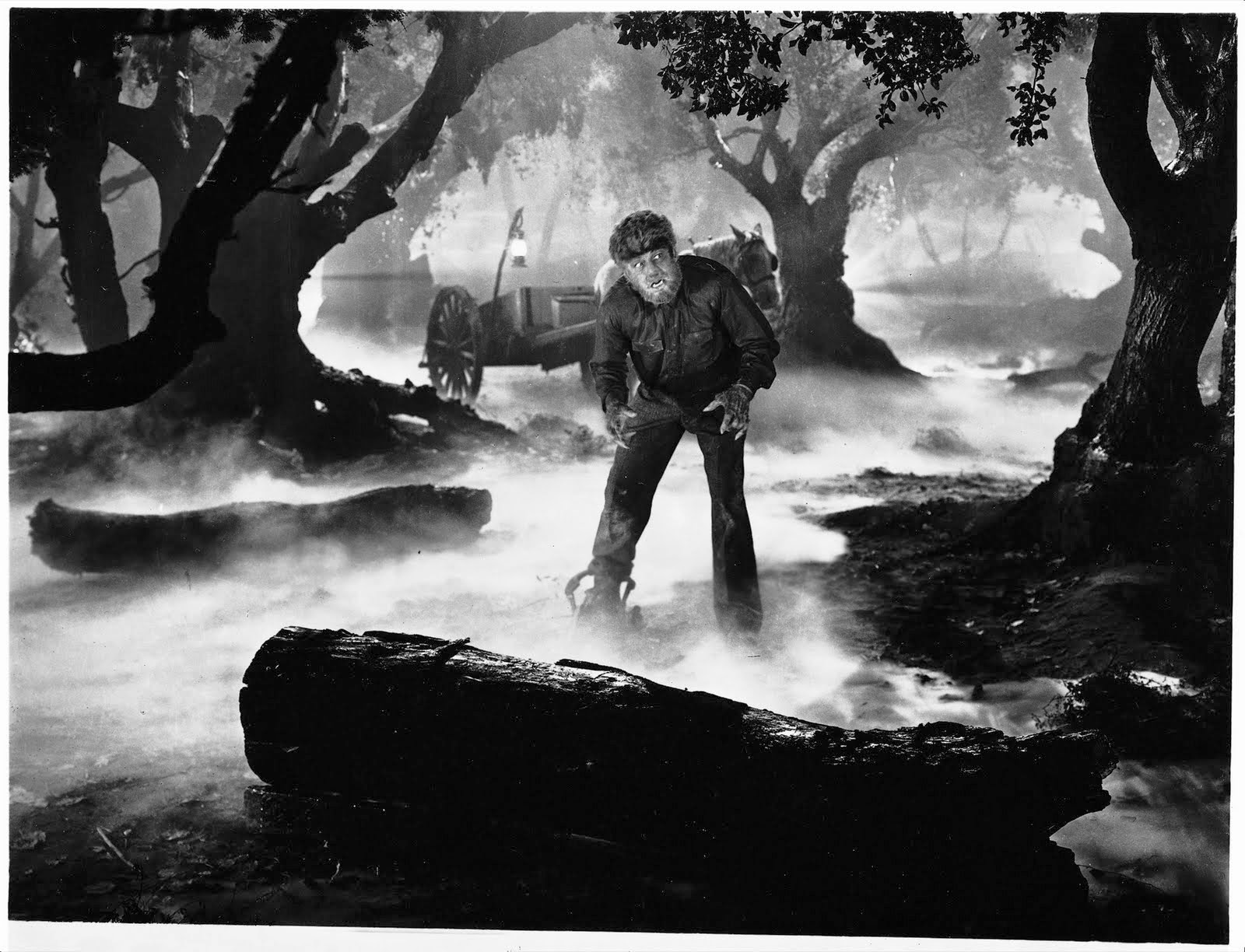
The Wolf Man (George Waggner, USA, 1941, 70 min.)
Viewed on Netflix            Second Viewing

The Wolf Man has never had the same iconic or allegorical resonance as Dracula (1931) or Frankenstein (1931), but it still benefits from the timeless production values and streamlined storytelling of the classic Universal horror house style.  Jack Pierce’s makeup effects remain impressive to this day, and the fog-drenched wood sequences are wonderful showcases for Joseph Valentine’s black and white cinematography and Jack Otterson’s art direction.  In many ways this is shallow box-office fodder, but it comes from an era when audiences could rely on generic blockbusters to be executed with style.  B-