
Oedipus Rex (1967) marks an undeniable turning point in the
filmography of Pier Paolo Pasolini.
Where Hawks and Sparrows
(1965), for all of its virtues, felt in many ways like a tentative and somewhat
awkward attempt to move forward after The
Gospel According to St. Matthew (1964) brought the thematic concerns of
Pasolini’s series of Christian films to their logical endpoint, Oedipus Rex is unmistakably a confident
step into new territory for the writer-director. The black and white
conflations of Christianity and gritty neorealism that comprised Pasolini’s
early film works here give way to boldly colorful re-interpretations of classic
myths, while primitive tribal music replaces the classical pieces used for the
early films’ soundtracks. In melding a
completely new aesthetic direction with an eccentric and highly personal take
on Sophocles’ legendary tale, Pasolini set a new path for his oeuvre and
finally left any lingering traces of conventional Italian neorealist cinema
behind him.
As if to mark Oedipus
Rex as a sort of second debut, Pasolini cast Franco Citti, who began his
acting career as the protagonist of Accattone
(1961), as the titular figure. Citti’s
raw, plainly emotional performance played a huge role in the success of
Pasolini’s first film, but his bracingly energetic work stands out even more in
the context of an adaptation of a Greek legend.
The cries of rage and anguish that Oedipus periodically lets out are
visceral even with the inevitable remove provided by the post-synched dialogue
(which was standard in Italian cinema of the time). Pasolini’s Oedipus is far from a stuffy, scholarly take on Sophocles; it feels
immediate and impassioned in a way that few adaptations of classic literature
do. The controversial writer-director
wasn’t aiming for a respectable middlebrow adaptation of a world-renowned work
of art – he was out for blood.
Pasolini clearly did not take the transition to color
cinematography lightly. While Pasolini’s
use of color is not as extreme as in Michelangelo Antonioni’s contemporaneous
first color film Red Desert (1964),
which included such bizarre sights as hand-painted trees, the vibrant sun-dried
look of Oedipus Rex’s Moroccan desert
locations is nonetheless a rather flamboyant change of pace from the stark
black and white of Pasolini’s early films.
The writer-director didn’t start his film career as a particularly
visually oriented director. While there
are some striking shot compositions in Pasolini’s earlier films, such as the
headlight-lit gang rape of a prostitute in Accattone
and the walking-on-water scene in The
Gospel According to St. Matthew, those films seemed more oriented around their
thematic ideas than their visual design.
Oedipus Rex reverses the
equation, as the film plays like a series of beautiful, strange images that are
supported by an elusive interpretation of a classic text. It isn’t clear why the film, which mostly takes
place in the same setting as Sophocles’ story, opens with a scene in pre-WWII
Italy and closes with a scene in 1960s Italy, but the aggressively odd imagery
gives the film a compelling poetic logic.
The scene where Oedipus unknowingly murders his father and
his entourage is a tour de force for Pasolini and cinematographer Giuseppe
Ruzzolini, who punctuate the stabbings with blinding flashes of sunlight rather
than the expected showers of blood. But
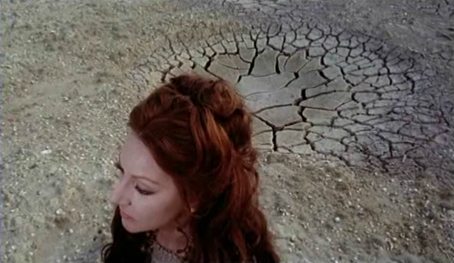
there is something interesting to look at in literally every shot, whether it
is the wonderfully grungy tribal costumes worn by the cast or the impressively
rugged Moroccan scenery or the inscrutable facial expressions of Silvana
Mangano, who plays Oedipus’ mother. Oedipus Rex isn’t the type of stiff,
overly composed art movie that insists on its creators’ mastery. The cinematography, for all of its beauty,
retains a rough, visceral shakiness that makes the film feel like an improvised
oil crayon drawing come to life.
Pasolini followed Oedipus
Rex with Teorema (1968) and Porcile (1969), both of which we’ll look
at next month, and then returned to Greek myth with his take on Medea
(1969). But where Oedipus Rex marked a bold stylistic departure for Pasolini, Medea feels almost like a poor man’s
repeat of its sister film. Up to this
point, Pasolini hadn’t ever come close to repeating himself, each new film
feeling in some way like an advancement of ideas presented in earlier works,
but Medea finds the director covering
the same territory as he did in Oedipus
Rex without improving on that film in any way.
There is still an abundance of extraordinary imagery (this
time provided by ace cinematographer Ennio Guarnieri, working with Turkish
locations), and the audio assault of esoteric African and Balkan folk music is
impressive and distinctive. Medea is too exotic to be truly dull,
but Pasolini’s take on the material is tediously repetitive, awkwardly
structured, and dramatically inert.
Jason (Giuseppe Gentile) is initially presented as the film’s
protagonist, before the perspective abruptly shifts to Medea (opera legend
Maria Callas, acquitting herself nicely in her only film role ). Jason’s betrayal of
Medea, which sets most of the actual plot in motion, happens late in the film
and mostly offscreen, which makes it hard to have any sort of reaction to her
violent revenge on Jason’s family. That
revenge is also inexplicably presented in two successive, barely
distinguishable versions to no discernible dramatic effect. A few of Pasolini’s films up to this point
have been problematic for one reason or another, but Medea is the first one that finds the director repeating himself.
UP NEXT Teorema and Porcile
