Tuesday, August 28, 2012

Understanding Auteurs: Pier Paolo Pasolini (The Trilogy of Life)


After stumbling with the half-baked provocation Porcile (1969) and ripping off his own Oedipus Rex (1967) with the noticeably weaker Medea (1969), Pier Paolo Pasolini sought a new creative direction with a series of films that he dubbed the Trilogy of Life.  The director’s first three movies of the ‘70s were each adaptations of beloved medieval texts, each of which are an anthology of shorter tales.  Pasolini’s versions of these books would emphasize the gritty carnality of the original text, while ostensibly providing a lighthearted examination of the intersection between art and everyday life in the pre-industrial world.

The trilogy begins with The Decameron (1971), based on Giovanni Boccaccio’s Italian classic collection of one hundred stories.  Pasolini’s version only includes a fraction of the stories, and is missing Boccaccio’s framing story, in which ten young people gather to relate the tales to each other.  The lack of any sort of structuring principle to Pasolini’s script makes The Decameron feel like one of his least disciplined efforts.  Pasolini does introduce a recurring motif about halfway through the movie that follows a painter (played by Pasolini himself) who searches for inspiration while painting a cathedral, but there is no rhyme or reason to why this story needed to be told in such a fragmented way while most of the other tales are given their own individual segments of the film.  Many of the stories have promising setups, but none of them really feel like they come to a point before the film arbitrarily moves on to a new story.  Pasolini’s determination to preserve the bawdiness of the original text rather than making a stuffy Masterpiece Theater episode is admirable, and he does conjure up a convincing overall depiction of medieval Italy.  But the plotting in The Decameron is way too lackadaisical, especially considering that the movie is meant at least partially as a tribute to storytelling.  With its lazy pacing, seemingly arbitrary structure, and generally inconsequential tone, The Decameron resembles many of Fellini’s films from this period; like Satyricon (1971) or Roma (1972), The Decameron mostly seems like an excuse for its director to indulge himself.  Where Fellini at least has enough technical skill to occasionally make this aimless, masturbatory style work, Pasolini remains a fairly straightforward stylist (albeit one with a good eye for exotic locations), and the eccentric social commentary that distinguishes most of his oeuvre is almost totally absent here.

Unfortunately, there is hardly any more depth to the second film in the trilogy, the Geoffrey Chaucer adaptation The Canterbury Tales (1972).  As in the previous film, Pasolini jumbles the order of tales arbitrarily, while removing the original text’s framing story – though in this case he alludes to it by having a character suggest that a group of villagers take turns telling stories as they travel to Canterbury, which only makes it more awkward when the film completely abandons this structure.  Pasolini again appears in a quasi-framing story, this time playing Chaucer himself, though these brief scenes mostly only consist of the author sitting in front of his notebook and laughing to himself about his writings.  A few of the stories are lightly amusing, such as one where a jolly beggar made up to look like Chaplin’s Little Tramp (Pasolini favorite Ninetto Davoli, who actually looks more like Chico Marx) attempts various hustles in exchange for food, but the film’s rambling structure only allows it to work on a moment to moment basis.  Where The Decameron could at least boast some interesting, highly photogenic locations, The Canterbury Tales feels constrained by its somewhat bland British locations (despite the fine work of cinematographer Tonino Delli Colli).  Pasolini’s depiction of medieval England is not as immersive as his portrayal of primitive Italy, mainly because of his distracting decision to dub the dialogue into English even though most of the actors are clearly speaking Italian.  Why Pasolini didn’t simply hire an English-speaking cast is a mystery, though his decision to stick with recurring cast members like Davoli and Franco Citti is consistent with the generally lazy and carefree feel of this film and The Decameron.  There is a crazy low-budget vision of Hell toward the end of the movie (with screaming demons firing out of Satan’s ass in what appears to be the same volcanic wasteland seen in Porcile and 1968’s Teorema), but it may not be worth sitting through the rest of this tediously inconsequential effort to get to the rare good moments.

Considering the slump that Pasolini seemed to be in after Porcile, Medea, The Decameron, and The Canterbury Tales, it is almost shocking that Arabian Nights (1974) is as vital as it is.  The final film of the Trilogy of Life shares many traits with the first two parts, including some of their flaws, but overall it is the first of Pasolini’s exotic pagan films to live up to the beauty of Oedipus Rex.  Somehow the rambling structure of Arabian Nights works where it fails in the previous two films, perhaps because Pasolini actually allows the stories time to develop and come to a conclusion before abruptly moving on.  There are still some odd scripting decisions – such as having a young hero (Franco Merli) enjoying an orgy in one scene before being inexplicably distraught in his next appearance – but the overall atmosphere of Arabian Nights is spellbinding enough to make the film feel like the only truly coherent chapter of the Trilogy of Life.  The mysterious, poetic Arabic tales are a good match for Pasolini’s aesthetic, and the flights of fancy are nicely balanced by the earthiness that Pasolini brings to the film’s frequent good-natured sex scenes (with their nicely matter of fact handling of both male and female nudity).  With its consistently gorgeous imagery and its compelling mixture of fantastical storytelling and raw carnality, Arabian Nights single-handedly justifies the highly flawed Trilogy of Life.

UP LAST  Salo

Friday, August 24, 2012

Processing Women in Love


Expectations  I’ve never been a very big fan of the films of Ken Russell.  I’m not in the minority on this issue, either.  Critics were generally never fond of Russell’s gaudy, in-your-face hyper-stylization.  The British director’s 2011 death sparked a handful of obligatory obituary tributes, but I’m not aware of any passionate reassessments of his body of work or any major theatrical or DVD re-releases of his best-known films.  Nor can I say that any of the Russell films I’ve seen really deserve such treatment.  Russell’s version of The Who’s rock opera Tommy (1975) is one of the few cases where his sledgehammer style works decently, as it distracts from Pete Townshend’s silly narrative and turns the film into a series of music videos highlighting exciting performances by the likes of Tina Turner and Elton John.  More often, Russell’s desire to throw as much random junk at the screen as possible results in unpleasantly chaotic messes like The Boy Friend (1971) or Lair of the White Worm (1988).  Presumably Russell wanted to make sure that his audience didn’t get bored, but the unvarying shrieking tone of many of his movies creates its own kind of monotony.  If the relentless stylization isn’t annoying enough, Russell often strained to shock with “risqué” subject matter, such as sexualizing a group of nuns in his controversial film The Devils (1971).

Still, there is something weirdly admirable about an artist who is determined to push everything into the red at all times, regardless of how tasteless or stupid it may seem.  And so I wind up giving Russell another chance about once a year or so, hoping to find a film where his chosen subject matter meshes with his orgiastic style.  Women in Love (1969) is the film that I’m giving a chance this time, and it actually seems like there’s a fairly strong possibility that it will prove to be worthwhile.  The D.H. Lawrence adaptation put Russell on the map after a bunch of TV work and a few small-scale features.  While Women’s critical legacy has dwindled somewhat in recent years, perhaps due to increasing exhaustion with Russell’s Grand Guignol aesthetic, it was a highly acclaimed and popular film around the time of its release, and it received a number of Oscar nominations (including one for Russell as a director) and one win (a Best Actress nod for Glenda Jackson).  Will Women in Love display a reined-in and focused Ken Russell, or at least feature a story that is a good match for his aesthetic?  Or will it just be another jumble of ideas?  I’m cautiously optimistic that it will at least be interesting.

Responses to the Film  Women in Love is indeed restrained and mature by Russell’s standards, perhaps owing to the fact that the project did not originate with him.  Producer Larry Kramer was obsessed enough with adapting D.H. Lawrence’s novel to the screen that he wound up writing the screenplay himself after finding the work of several writers he’d hired to be subpar.  Considering Kramer’s direct involvement with the creative side of the film’s preproduction, and taking into account the fact that Russell was a relatively unproven filmmaker in 1969 (he was the fourth choice to direct the film after luminaries such as Stanley Kubrick passed on the project), it seems likely that Kramer exercised some level of veto power any time Russell’s ideas became too extreme.  That said, Russell’s version of Women in Love is hardly a stuffy period piece, and it does benefit immensely from the director’s exotic touches.  Kramer may or may not have reined Russell in to some degree, but the director’s eccentricities are present enough to keep the film interesting even as they are held back enough to not completely overwhelm the story.

While watching Women in Love, I was actually grateful for Russell’s aggressive attempts to make the material more viscerally exciting because, frankly, the narrative of the film is not all that interesting on its own terms.  Basically the story, set in 1920s Great Britain, follows the titular women (Jackson and Jennie Linden) as they come into the orbit of a wealthy coal mining magnate (Oliver Reed) and his libertine friend (Alan Bates).  What follows includes a lot of ponderous (if sometimes beautifully written) discussions about the nature of love, as well as some scenes of desperately passionate sex.  There is a limit to how exciting that kind of story can be in its own terms, but Russell frequently spices things up with his wild stylistic tricks.  You wouldn’t necessarily expect a film about bored rich people arguing about the value of love to include multiple spastic dance scenes (including one in front of a herd of Highland cattle), smash cuts linking a pair of fresh corpses to two of the leads embracing tenderly, and a nude wrestling match that seems like a precursor to the unclothed fight scene from David Cronenberg’s Eastern Promises (2007), but all of that and more is included in Russell’s crazy vision.  For once, though, Russell’s weirdness doesn’t run roughshod over the rest of the film, and the characters are given room to develop rather than being turned into obnoxious, screeching cartoon stereotypes.  Though Jackson was the member of the cast generally singled out for praise around the time of the film’s release, all four leads give very strong performances.  Russell’s experimental style doesn’t always enhance (or even necessarily sync up with) what the actors are doing, but it doesn’t impede their performances either, and the movie overall strikes a fairly good balance between disciplined storytelling and puckish showboating.

Afterthoughts  It’s been almost a week since I watched Women in Love and wrote the preceding paragraphs, and I can’t say that I’ve given much thought to the movie in the interim.  The spastic direction and the stately story prevent the film from becoming either a boring period piece or a typical Ken Russell mess, but the two tones don’t really add up to a coherent vision either.  There are enough memorable moments and strong performances in Women in Love to make the film a worthwhile experience, but it just doesn’t seem like the filmmakers were all on the same page.  Russell’s eccentric stylistic flourishes are often pretty cool on their own terms, but they don’t do much to enhance the movie’s themes or its story, beyond keeping it from getting too dull.

Still, Women in Love is easily the best of the Ken Russell films I’ve seen.  Women in Love’s style and its substance don’t entirely coalesce, making the film less emotionally impactful than it was presumably meant to be, but the handsome production values, unexpected formal touches, and all-around solid performances make the movie well worth any cineaste’s time.  If nothing else, Women in Love is certainly the most accessible of Ken Russell’s films and a good entry point for anyone who might be interested in looking into his work further.  But it didn’t convince me that I’ve been wrong about the limitations of Russell’s aesthetic.

Saturday, August 11, 2012

Thoughts on Sight and Sound's 2012 Poll


The Top Ten Films of All Time – According to Sight and Sound’s 2012 Poll
1)  Vertigo
2)  Citizen Kane
3)  Tokyo Story
4)  Rules of the Game
5)  Sunrise
6)  2001:  A Space Odyssey
7)  The Searchers
8)  Man with a Movie Camera
9)  The Passion of Joan of Arc
10)  8 ½

The biggest news in the world of cinema is the recent announcement of Sight and Sound’s once-a-decade list of the best films of all time, as voted for by the world’s most prominent critics and filmmakers.  Sight and Sound have been publishing the list once every ten years since 1952, and it has come to be regarded by most cinephiles as the closest thing to an official film canon; Citizen Kane’s (1941) status as “the greatest film of all time” came about because it topped every list from 1962 to 2002 (the original 1952 poll favored Vittorio De Sica’s 1948 neorealist classic Bicycle Thieves).  Perhaps the most surprising, and widely reported about, development of the 2012 list is that it is not topped by Kane, or by perennial number 2 or 3 Rules of the Game (1939), but by Alfred Hitchcock’s Vertigo (1958), a film that has been slowly creeping up the top ten since appearing as a runner-up in the 1972 list.

Like Kane, Vertigo was not widely appreciated in its own time, and was a failure at the box office as well as with critics.  Today Vertigo’s status as a masterpiece is rarely disputed, though Hitchcock’s long string of classics makes choosing a definitive work difficult.  Personally, I’ve never been able to decide whether I prefer Vertigo or Rear Window (1954), but if I were including a Hitchcock film on my own hypothetical ballot for the Sight and Sound poll – which is meant as a list of “best” films rather than “favorites,” assuming that it’s possible to make such a distinction – I would have to give the edge to Rear WindowVertigo is undeniably the grander auteurist statement, a hypnotic and eccentric waking dream from a director whose obsessions clearly lined up with those of his protagonist Scottie (James Stewart), who becomes hopelessly fixated on a woman (Kim Novak) he’s supposed to be investigating.  Hitchcock’s 1958 classic is the most intense and emotionally expressive of his films, but Rear Window is the easier film to make a logical argument for placing on a list of all-time greats.  A model of perfect narrative construction and a triumph of old Hollywood craftsmanship, Rear Window is about as close to flawless as movies come.  The film’s meta fascination with voyeurism satisfies intellectually, providing the bedrock for decades of film theory.  Meanwhile, the incredibly tight plotting, the likeable performances of an all-star cast, and Hitchcock’s customary stylishness combine to make Rear Window the most conventionally entertaining of the director’s films.

Whether Vertigo deserves the top spot over Citizen Kane is also debatable.  It’s hard to compare Vertigo to Kane, since the films have radically different goals and wildly dissimilar styles.  Few serious cineastes would argue with either films masterpiece status, but it’s easy to see that Kane has ultimately had the greater impact on the history of the medium.  Kane brought all of the innovations of pre-‘40s cinema up to date and virtually created (and/or perfected) a number of stylistic and narrative techniques that still feel fresh today, all while telling a grippingly funny and tragic story about the rise and fall of a complicated individual.  Vertigo is no less entertaining than Kane, and in some ways it is the more fascinating film from an auteurist perspective.  Hitchcock’s film is certainly more autobiographical than Orson Welles’ (though the fact that Welles played the lead role in Kane has understandably led many to mistakenly compare the titular tyrant to the free-spirited Welles).  Still, Vertigo can’t be said to have had as much influence on the state of the art as Kane has.  Kane is essentially a summary of all that came before it and an inspiration for everything that came after it, a feat that very few works of art can boast.  It may have been a bit boring to see Citizen Kane retain its Sight and Sound championship, but it is a definitive and logical top choice in a way that Vertigo simply isn’t, even though the two films are equally enjoyable.

Obviously this is an extremely nitpicky argument to make.  As I hope I’ve made clear, I do really love Vertigo, a film that will certainly appear on my long-in-the-works list of my 100 favorite movies (which I hope to post on this site by the end of the year, though I’m not making any promises).  I’m just not sure that it’s as definitive a piece of film history as some of the other movies on Sight and Sound’s list.  I also don’t want to put too much effort into criticizing the list itself, since all of the movies on it are genuinely important works of art.  Personally, I’ve never been a fan of Yasujiro Ozu’s Tokyo Story (1953), but I’m willing to accept that that may simply be the result of my not having seen it in nearly a decade, or of me simply not connecting with the Ozu aesthetic that has bowled over many people whose opinions I respect (though I feel fairly comfortable calling Leo McCarey’s 1937 film Make Way for Tomorrow – Ozu’s acknowledged inspiration for his most famous work – the better movie).  I also think that John Ford’s The Searchers (1956) is a bit more morally compromised than its reputation suggests, as its criticisms of western mythology are a lot less rigorous and honest than those in Ford’s own The Man Who Shot Liberty Valance (1962) or Jim Jarmusch’s Dead Man (1995), though as pure cinema it is as good a representation of the western genre as any. 

Of course my personal top ten list would look different than the one compiled for Sight and Sound, but it’s hard to quibble too much with the films included, most of which are simultaneously definitive in terms of their import to the history of cinema and eccentrically singular in terms of their stylistic and thematic focuses.  I might slightly prefer Jean Renoir’s Grand Illusion (1937) to his Rules of the Game, Carl Theodor Dreyer’s Day of Wrath (1943) to his Passion of Joan of Arc (1928), and Stanley Kubrick’s Barry Lyndon (1975) to his 2001:  A Space Odyssey (1968), but in each case the film that actually made the list has had more of an impact on the medium (and preferring any one of these great films to another essentially amounts to splitting hairs).  Perhaps the boldest and most exciting development on the list is the brand-new inclusion of Dziga Vertov’s insane Dadaist experimental documentary Man with a Movie Camera (1929), which essentially replaced Sergei Eisenstein’s persistent favorite (and worthy contender) Battleship Potemkin (1925) as the list’s nod to classic Soviet montage. 

While it’s a shame that filmmakers as important as Eisenstein, Charlie Chaplin, Buster Keaton, Luis Bunuel, Jean Vigo, Michael Powell, Nicholas Ray, Howard Hawks, Akira Kurosawa, Robert Bresson, Jean-Luc Godard, Chris Marker, Andrei Tarkovsky and Abbas Kiarostami (to name just a few that immediately come to mind) couldn’t crack the top ten with any of their major works, it has to be acknowledged that only a handful of slots are available and that we’d be equally likely to bemoan the absence of any of the ten directors whose films do appear on the list had they not made it.  Dive into the extended top fifty list and you’ll see classics from many of the directors mentioned above, alongside some wonderfully cutting-edge choices like Jacques Tati’s Playtime (1967) and Chantal Akerman’s Jeanne Dielman (1975).

Having said all that, I’d like to lament the continuing absence of Fritz Lang’s M (1931) from the Sight and Sound list.  While few cinephiles would deny M its status as a classic, it rarely seems to be considered when debates about the greatest film of all time arise.  Metropolis (1927) has become known as Lang’s official masterpiece – which is understandable considering the pronounced influence the film continues to have on the science fiction genre, but perhaps harder to argue for when one considers its incoherent mishmash of half-understood competing ideologies.  That Metropolis isn’t Lang’s greatest film says more about the director’s incredible oeuvre than it does about any failings of the film itself, but M is certainly the better film and in many ways an even more important one.  Conceived at the nexus of silent and sound film, M provides the best of both worlds, as Lang liberally incorporates elements of the silent style that he’d mastered while also making some profoundly groundbreaking use of the new sound technology.  M’s innovative and flashy method of linking scenes by having a character finish a sentence that another one in a completely different setting started clearly had a major impact on the transitions in Citizen Kane, and arguably is used to greater purpose in M, which memorably depicts an entire city whipped into a frenzy as they attempt to capture a child murderer (Peter Lorre).  With its impeccable and still modern style, its tight narrative, its profoundly challenging morality, and its unforgettably disturbing glimpse into the psyche of Germany in the immediate pre-Nazi era, M is my choice for the greatest film of all time.

Saturday, July 28, 2012

Understanding Auteurs: Pier Paolo Pasolini (Teorema and Porcile)

Teorema (1968) is perhaps the most difficult of Pier Paolo Pasolini’s films up to this point, a work that brings many of the director’s pet themes to their logical conclusion while remaining almost maddeningly elusive about what those conclusions are.  Rather than follow the sea change in aesthetics and theme that Oedipus Rex (1967) seemed to suggest, Pasolini again pursues the conflict between Italy’s Christian ideals and its complacent bourgeois realities.  But the conclusions that the writer-director reaches in Teorema are far less easy to summarize than those in Mamma Roma (1962) or The Gospel According to St. Matthew (1964), both of which made challenging but easy to identify points about the cultural confusion of the society that Pasolini lived in.  One can come to certain conclusions about various thematic aspects of Teorema, but there is far more ambiguity built in to this film’s structure than there is in Pasolini’s previous films.

Teorema focuses on a typical upper-middle class nuclear family whose daily routines are disrupted by the inexplicable arrival of a strange, quiet man listed in the credits as “the Visitor” (Terence Stamp).  The Visitor seems to bring out the latent desires and frustrations in every member of the household, prompting them each to make bold changes in their lives.  The father (Massimo Girotti) decides to give up control of his business, letting his workers take charge.  His wife (Silvana Mangano, returning from Oedipus Rex) experiences a sexual awakening, feeling passions that have presumably disappeared from her dull married life.  The son (Andres Jose Cruz Soublette) realizes to his shame and humiliation that he is a homosexual, with the Visitor allowing the boy to experience what is apparently his first same-gendered sexual experience.  The daughter (Anne Wiazemsky) tentatively breaks free from her sheltered “good girl” status through her own sexual relationship with the Visitor.  Even the maid (Laura Betti) is affected by the strange man’s presence, as he prevents her suicide attempt and ultimately prompts her to return to the humble village where she grew up.

The Visitor leaves the family just as abruptly as he arrived, and his disappearance has a tremendous impact on the household.  Only the maid seems to take a positive inspiration from the mysterious guest’s visit, as she begins to perform miracles in her old village, ranging from curing a child of what appears to be leprosy to mysteriously floating above a building.  Once again Pasolini seems to be suggesting that the poor are closer to the peasant roots of spirituality and are therefore the only ones in a position to accept true religion.  This positive interpretation is complicated, however, by the bizarre and highly ambiguous conclusion to the maid’s story, which finds the woman instructing one of her disciples to bury her alive for no discernible reason.  

The effect that the Visitor’s leaving has on the bourgeois family is no less mysterious, and in many ways more interesting than what happens to the maid.  It would be easy for Pasolini to take a high and mighty position and mock the wealthy family for their banal concerns.  But although the members of the family are used more as representative figures than fleshed-out characters, Pasolini seems to empathize and even identify with their existential struggles.  The son who struggles with his sexual identity is going through feelings that Pasolini undoubtedly dealt with as a homosexual growing up in a macho culture, and the fact that the son ultimately channels his frustrations through increasingly violent abstract art suggests a particularly bracing autocritique.  The wife’s futile search for transcendence through tawdry sex with young hustlers may have also hit close to home with the writer-director, who was allegedly murdered while attempting to pick up a gigolo.  Pasolini’s biggest howl of despair comes from the father, who renounces all ties to his business, strips himself of his clothes, and goes out into nature.  But the father cannot simply become one with the world in the style of Saint Francis.  He is too much a product of his middle-class industrial world to escape from it, and the film ends with him utterly lost in the middle of a weird volcanic wasteland, screaming incoherently at the camera.

The mysteries revolving around who exactly the Visitor is (he could be interpreted, with equal justification, as a Christ or Satan figure) and how much he can be held accountable for the destinies of the family make Teorema the most challenging and intellectually stimulating of Pasolini’s films to this point.  At the same time, the intense yet ambiguous directions that the family members go in following the Visitor’s departure may make this the most nuanced and complicated of Pasolini’s provocations at this point.  That said, while Teorema is a triumph of bold thematic complexity, the script’s poetry doesn’t necessarily translate cinematically.  Where Oedipus Rex presented a huge leap forward for Pasolini as a visual stylist, Teorema is somewhat clunky from a directorial standpoint.  Aside from the highly memorable aforementioned final shot, and the effective use of Terence Stamp’s passive yet intensely sensual stare, Teorema is pretty basic on a visual level, with some of Pasolini’s overt attempts at stylization falling flat.  An early scene is arbitrarily presented in the style of a silent film, which might have at least been a charmingly weird diversion if Pasolini were more technically equipped to actually replicate the style of early cinema.  While the film is smartly and logically structured overall, it nonetheless opens awkwardly with a TV news-style report about the father’s business, a scene that could have easily been cut from the film altogether.  Teorema isn’t an easy film to warm up to, and in some senses it is a stylistic failure, but it is undeniably a major statement.

Unfortunately, the same can’t be said for Pasolini’s next film.  Porcile (1969) is the most outwardly confrontational of Pasolini’s films to this point, and it was clearly intended to provoke a strong, possibly hostile response from its audience - which would be fine if it was at all clear what the writer-director was trying to say with this very muddled effort.   The film is divided between a mostly dialogue-free story set in the distant past that follows a man (Pierre Clementi) as he is mysteriously hunted through the same volcanic hellhole that was featured in the final shots of Teorema, and modern-day scenes set in a villa occupied by a Nazi-turned-businessman (Alberto Lionello) and his bored son (Jean-Pierre Leaud).  Continuous cross-cutting between the two stories suggests that Pasolini means to draw some parallel or contrast between the old-fashioned barbarism of the medieval story and the contemporary fascism found in the latter story, but it isn’t even remotely obvious what Pasolini’s intentions in combining the two stories are. 

While Pasolini’s films have sometimes felt a bit blandly directed, the strength of their ideas has usually made up for any visual deficiencies.  But Porcile seems intended only to provoke a knee-jerk response of disgust from the viewer, and ultimately fails even on the level of pure shock value.  For a film that prominently features cannibalism, beastiality, and Nazi war atrocities, Porcile feels awfully tame, allowing most of its potentially disturbing material to happen offscreen.  Most of the contemporary material is devoted to tedious scenes of the Nazi and his business associates tediously tossing half-baked philosophies at each other, or Leaud and his fiancée (Wiazemsky, returning after Teorema) sharing some abstract political frustrations.  The material set in the past fares somewhat better, if only because of the stunningly odd volcano location, but it mostly feels like a poor man’s version of Oedipus Rex, or even Medea (1969). 

The post-synched dialogue proves to be more of a problem in Porcile than it has in previous Pasolini films.  For the most part, audio sync hasn’t been a major issue in Pasolini’s previous films, though it is a little awkward to see Orson Welles’ part clearly dubbed over by a different actor in La ricotta (1963).  Where the Welles character was not a major focal point of La ricotta, Jean-Pierre Leaud is an important character in Porcile.  It is really distracting to see the well-known stand-in for the French New Wave being clearly dubbed by an Italian actor while playing a German character.  It is understandable that Pasolini would want to work with Leaud, one of the best and most intense actors of his era, but he is terribly miscast in this role.  The post-dubbing of Welles’ character in La ricotta is undeniably distracting, but there is enough else going on in that short film to nullify the issue.  Porcile, on the other hand, is nothing but a series of awkward, half-baked ideas signifying nothing.  With the murky, confused Porcile and the redundant Medea, Pasolini seems to be in a bit of a slump.  Hopefully his next project, a trilogy based on classic works of literature, will reinvigorate his art.

UP NEXT  The Trilogy of Life (The Decameron, The Canterbury Tales, and Arabian Nights)


Saturday, July 21, 2012

Processing I Was Born, But...

Expectations  The filmography of Yasujiro Ozu is perhaps the biggest blind spot in my knowledge of cinema.  Few filmmakers are as highly respected as Ozu within the critical community.  Aside from Akira Kurosawa, and perhaps Kenji Mizoguchi, Ozu is the most widely beloved of all classical Japanese directors, and his trademark minimalist aesthetic has left an indelible mark on the styles of modern masters ranging from Hou Hsiao-hsien to Jim Jarmusch.  Since I consider myself an admirer of all of the aforementioned filmmakers, as well as a number of the critics (such as Jonathan Rosenbaum, Roger Ebert, and Donald Richie) who consider themselves Ozu enthusiasts, I am a little bit ashamed to admit that I’ve mostly been bored by the few Ozu films I’ve seen.  Even Tokyo Story (1953), the director’s signature work, which is often cited as one of the greatest achievements in cinema, mostly registered as a dull chore to me when I saw it in college (though that was long enough ago that the film is probably due for a re-viewing).  I can respect naturalism and minimalism in film as long as the story, characters, and/or setting are interesting enough to keep the work compelling, but whatever makes Ozu’s projects special (beyond his undeniably distinctive tendency to frame his shots from the perspective of someone sitting on a tatami mat) has completely eluded me at this point.

Perhaps Ozu’s famous films of the ‘40s, ‘50s, and ‘60s are simply not for me, but rumor has it that his silent era work is in quite a different style, less slow-moving and more comic than his well-known understated sound dramas.  I recently attended a screening of A Story of Floating Weeds (1934), the only silent Ozu film I’ve seen at this point (he didn’t start working with sound until 1936), and was pleased to find that it was much more entertaining and, from my perspective, much more evidently lyrical than his sound films that I’d previously seen.  Floating Weeds still seemed a little too minor and rudimentary to me to qualify as an important work, but I was more engaged by it than I was by the later Ozu films that I’m familiar with.  I’m hoping that the oddly titled I Was Born, But… (1932), which is generally the most highly regarded of Ozu’s silent films, will be the one that finally makes me understand what I’ve been missing in his work.

Responses to the Film  In comparison to Ozu’s sound films that I’ve seen, I Was Born, But… is fairly conventional on a stylistic level.  Where late-period Ozu films like An Autumn Afternoon (1962) stubbornly refuse to divert from their highly specific yet blandly rigid shot compositions and painfully slow editing patterns, I Was Born has a relatively fast pace that feels entirely appropriate for the child-eye perspective of its narrative.  The film follows two grade-schoolers (Tomio Aoki and Hideo Sugawara) as they ditch class while trying to hide their clandestine activities from their father (Tatsuo Saito), whom they look up to and fear in equal measure.  The boys’ view of their father is irrevocably altered when they see him behaving submissively in front of his boss and colleagues.  Misunderstanding the necessary compromises of adult life, the children begin to view their father as a weakling, which brings the father’s own latent feelings of inferiority and disappointment to the surface.

One of the most striking things about I Was Born, But… is how genuinely natural it seems.  It is rare to see such life-size storytelling or acting in a film from the silent era, but everything in Ozu’s film feels plausible and lived-in.  Ozu’s later work can sometimes seem like it is straining too hard to appear unadorned and realistic, but I Was Born offers a convincingly low-key look at the world of schoolchildren (and at the world of adults as viewed through the eyes of schoolchildren).  On a pure laugh out loud basis the film can’t compete with the silent era work of Charlie Chaplin or Buster Keaton, but Ozu isn’t providing jokes here so much as he is bemusedly observing the behavioral patterns of young children, while also casting a cutting yet sympathetic light on the absurdities of the grown-up world of business.  When the film becomes a bit more melancholy and serious in its last thirty minutes, the effect isn’t remotely jarring, because the understated performances of Aoki, Sugawara, and Saito undercut the script’s potential for melodrama as surely as they prevent the earlier part of the film from feeling like an extended episode of Little Rascals.  Whatever the film lacks in obvious, easy entertainment, it makes up for in bittersweet insight into the pleasures and pains of growing up.

Afterthoughts  I Was Born, But…  is not the type of movie that necessarily impresses right away, despite being more conventionally entertaining than some of Ozu’s other well-known works.  But it is a movie whose truly realistic tone and casually insightful comparisons between the world of schoolchildren and the business world of adults has stuck with me days after watching it, and that I suspect I will continue to think about for a long time to come.  Aoki and Sugawara are an unforgettable duo, full of charisma and charm even though (or perhaps because) the film never goes out of its way to make them seem adorable.  Saito is completely credible as their father; one can see how he would be both a beloved patriarch at home and a man who has resigned himself to a slightly boring life as a modest businessman.  The film’s understanding of the relationship between its three central characters is the source of all of its humor and drama.  Perhaps if Ozu ever went for jokes or pathos he would’ve made a more obviously “hilarious” or “moving” picture, but the film’s bemused, observational tone got in my head in a way that a more calculated movie would not have.

I can’t say that I Was Born, But… has made me a full-blown Ozu fan, but it is hands-down the best of his films that I’ve seen.  It creates a genuine sensation of realism, whereas some of Ozu’s sound era films seem to underline their modest style to such a degree that they become unconvincing (as well as dull).  I used to avoid seeing Ozu movies for the most part, but I can now appreciate his silent era aesthetic, and I look forward to seeing such movies as That Night’s Wife (1931), a film that has been described improbably but intriguingly as “Langian,” and Tokyo Chorus (1931), one of the film’s that challenges I Was Born’s title as Ozu’s most popular silent film.  Maybe it’s time to give Ozu’s more famous sound era work a second chance as well.  Good Morning (1959) is actually a partial remake of I Was Born, But…, so that might be a good place to start, but there are certainly many other highly acclaimed films to choose from.


Saturday, July 7, 2012

Processing Last Year at Marienbad


The structure of this post is borrowed from Jonathan Rosenbaum’s classic essay “Edinburgh Encounters:  A Consumers/Producers Guide in Progress to Four Recent Avant-Garde Films”

Expectations  There are few major filmmakers who I feel less qualified to write about than Alain Resnais.  I can respect his position as a massively important director who played a huge role in defining the European “art cinema” that polarized intellectuals in the ‘50s and ‘60s, but I haven’t found the same level of pleasure in watching his films as I have in those of his Left Bank contemporaries (and sometime collaborators) Chris Marker, Jacques Demy, and Agnes Varda.  This is not just a matter of the few Resnais features I’ve seen failing for me on a pure entertainment level – they’ve also seemed stubbornly opaque on a thematic level, sticking rigorously and humorlessly to a distanced aesthetic that seems designed to force home a point that I am nonetheless completely missing.  Hiroshima mon amour (1959) and Last Year at Marienbad (1961) both sailed over my head when I watched them in college, and the stern, austere tone of Resnais’ direction has thus far prevented me from exploring his latter feature filmography much further.

I’m not proud of not getting it, and the support that many critics and filmmakers that I respect have given to Resnais over the years makes me suspect that the fault is with me rather than the films themselves.  Great works of art tend to be confounding, and while some have an immediate impact that compliments their challenges, others need time to reveal themselves.  A number of films that I would now rank among my all-time favorites, such as Robert Bresson’s Pickpocket (1959), Jean-Luc Godard’s Contempt (1963), and Jacques Tati’s Playtime (1967) (to stick with French examples), confused and/or bored me on my initial viewing, only announcing their many virtues on latter viewings and further reflection.  Given the controversial cultural position that Last Year at Marienbad held in the early ‘60s, when it was simultaneously a surprise multiple Academy Award nominee and one of the targets of Pauline Kael’s influential anti-“art film” essay “The Come-Dressed-as-the-Sick-Soul-of-Europe Parties,” there must be more to the film than the tedious, pretentious navel gazing that I remember.

I also saw Marienbad under less than ideal circumstances in college, on one of those sad early VHS’ where the film seemed to have barely been remastered (or even formatted to fit the screen) in any way.  The gorgeous still shots I’ve found of Marienbad on the Internet bear little to no relationship to my memory of watching the movie on the dinky TV/VCR combo that I had in my college years.  Equally surprising are the mentions I’ve seen of the film being, on some level, a parody of Hitchcock and classic film noir; what I regarded as ridiculous self-seriousness may have actually been deadpan humor.  I also consider Resnais’ famous short essay film Night and Fog (1955) as the only properly serious film about the Holocaust, so I can’t bring myself to dismiss one of his most famous feature films simply because I vaguely remember it being boring and confusing.


Responses to the Film  The two stylistic aspects of Last Year at Marienbad that immediately stand out (and that continue to be striking for the duration of the film) are Sacha Vierny’s rich deep focus cinematography, and Francis Seyrig’s chintzy organ score.  A big part of what continues to make the film feel awkward and unpleasant to me is the unstable combination of these elements.  It feels at times like a bunch of footage from an unfinished Orson Welles film (since deep focus black and white unavoidably conjures thoughts of Citizen Kane) put through an Ed Wood post-production process (the obnoxious, virtually wall-to-wall organ music seemingly coming from an extremely low-budget horror film).  A large part of what Resnais seems to be after here is an investigation of the ways that different contexts can radically change the meanings of any given event, so it is possible that this bizarre collision of sound and image is intentional; and given how carefully Resnais has obviously controlled his images, it’s hard to imagine that he would lose control of the film’s soundtrack.  But the music is continuously distracting, an ugly blemish on the frequently breathtaking imagery.  It’s possible to get hypnotized by the aesthetics of a film like Mulholland Drive (2001) even if its meanings never become clear, simply because every aspect of its style feels dazzling and of a piece; but the equally baffling Last Year at Marienbad never fully takes off because its clash of styles doesn’t add up to a poetically coherent vision.

Still, Marienbad’s visuals are too impressive to ignore.  The film’s stiffness, which I found so off-putting on first viewing, is undeniably present, but now seems to me like part of an aesthetic strategy to alter the usual purpose of actors in movies.  Whereas a conventional narrative film would treat the people on screen as characters, Marienbad turns them into statues whose functions can be shuffled around depending on their position in the frame.  The humans-as-statues metaphor is made explicit in a lengthy sequence in which the two main screen figures, an unnamed man (Giorgio Albertazzi) and a woman (Delphine Seyrig) create a series of competing narratives explaining what an ambiguous lakeside statue might be depicting.  The male statue sees something and is pointing it out to the woman, says Albertazzi’s character, as the camera work seems to confirm his hypothesis; no, it’s the female statue who sees something and is calling it to the man’s attention, says Seyrig’s character, as the camera shifts position to suggest that she may be correct.

The statue sequence is essentially a mini version of the whole film.  It seems equally likely that Marienbad is a film about two lovers reuniting a year after their initial tryst, as Albertazzi’s character continually insists, or that the two are meeting for the first time, as Seyrig’s character argues.  The meaning of everything in the film is constantly in flux, which does undeniably make Marienbad an audacious and highly original experiment in narrative and cinematographic structure.  But because everything is up for grabs, the film lives or dies on the strengths of its individual moments, and is inherently somewhat of a hit or miss enterprise.  Some of the effects are pretty cool, such as a series of quick, white-hot flashes of a memory (or fantasy?) of Seyrig emerging from a speech that Albertazzi slowly delivers in a dark room.  The problem is that not every one of the film’s destabilizing effects is equally successful, and shoving them together in a non-stop succession prevents the film from being much more than an occasionally interesting, but frequently dull, parade of experiments.  

Afterthoughts While the experiments of Resnais (and screenwriter Alain Robbe-Grillet, a close collaborator who deserves roughly equal credit for the film) were certainly ahead of their time, they seem somewhat dated today.  Meta commentary on the nature of genre and narrative is now largely a tiresome cliché.  Intellectually, I can accept why Last Year at Marienbad would’ve been startlingly original in the early ‘60s, but it now feels a little bit old hat.  Granted, Marienbad’s utter lack of winking at the audience separates it from modern mainstream meta like Family Guy, and the film could conceivably work for someone as an evocation of erotic longing even if they miss the many nods to Hollywood melodrama.

But to the modern day viewer (or, at least, me), Marienbad’s deconstruction and reassemblage of suspense, melodrama, and noir clichés feels dated and off-putting.  The film is formally inventive but its deterministic tone feels weirdly rigid, as if Resnais was too reverent to the poetic pretensions of Robbe-Grillet’s script.  Marienbad doesn’t feel as playful as it needs to be to succeed as a droll comedy, but it also doesn’t feel substantive or intense enough to qualify as an effective drama.  On a pure formal level, the awful background music detracts from the impressive imagery.

Why does Marienbad fail for me, while Abbas Kiarostami’s Certified Copy (2010), which is also concerned with continuously reframing an ambiguous relationship between a man and a woman, largely succeeds?  Aside from my distaste for the organ music in Marienbad, which has no real corollary in Certified Copy, I think it has to do with Kiarostami’s comparatively low-key aesthetic and his willingness to let his lead actors (Juliette Binoche and William Shimmell) behave like real people, even if they pointedly seem like different real people at various point of the film.  Where Kiarostami manages to credibly evoke the beginning and the end of a relationship in surprising ways that sneak up on the viewer due to Certified Copy’s largely naturalistic aesthetic, Resnais beats the viewer over the head with Marienbad’s formalism to the point that his lead couple seem mostly like indifferent cogs in a machine.  Last Year at Marienbad deserves credit for innovation and daring, but it is a fundamentally flawed film that now seems like a relic of its era.

Friday, June 29, 2012

Understanding Auteurs: Pier Paolo Pasolini (Oedipus Rex and Medea)

Oedipus Rex (1967) marks an undeniable turning point in the filmography of Pier Paolo Pasolini.    Where Hawks and Sparrows (1965), for all of its virtues, felt in many ways like a tentative and somewhat awkward attempt to move forward after The Gospel According to St. Matthew (1964) brought the thematic concerns of Pasolini’s series of Christian films to their logical endpoint, Oedipus Rex is unmistakably a confident step into new territory for the writer-director. The black and white conflations of Christianity and gritty neorealism that comprised Pasolini’s early film works here give way to boldly colorful re-interpretations of classic myths, while primitive tribal music replaces the classical pieces used for the early films’ soundtracks.   In melding a completely new aesthetic direction with an eccentric and highly personal take on Sophocles’ legendary tale, Pasolini set a new path for his oeuvre and finally left any lingering traces of conventional Italian neorealist cinema behind him.

As if to mark Oedipus Rex as a sort of second debut, Pasolini cast Franco Citti, who began his acting career as the protagonist of Accattone (1961), as the titular figure.  Citti’s raw, plainly emotional performance played a huge role in the success of Pasolini’s first film, but his bracingly energetic work stands out even more in the context of an adaptation of a Greek legend.  The cries of rage and anguish that Oedipus periodically lets out are visceral even with the inevitable remove provided by the post-synched dialogue (which was standard in Italian cinema of the time).   Pasolini’s Oedipus is far from a stuffy, scholarly take on Sophocles; it feels immediate and impassioned in a way that few adaptations of classic literature do.  The controversial writer-director wasn’t aiming for a respectable middlebrow adaptation of a world-renowned work of art – he was out for blood.

Pasolini clearly did not take the transition to color cinematography lightly.  While Pasolini’s use of color is not as extreme as in Michelangelo Antonioni’s contemporaneous first color film Red Desert (1964), which included such bizarre sights as hand-painted trees, the vibrant sun-dried look of Oedipus Rex’s Moroccan desert locations is nonetheless a rather flamboyant change of pace from the stark black and white of Pasolini’s early films.  The writer-director didn’t start his film career as a particularly visually oriented director.  While there are some striking shot compositions in Pasolini’s earlier films, such as the headlight-lit gang rape of a prostitute in Accattone and the walking-on-water scene in The Gospel According to St. Matthew, those films seemed more oriented around their thematic ideas than their visual design.  Oedipus Rex reverses the equation, as the film plays like a series of beautiful, strange images that are supported by an elusive interpretation of a classic text.  It isn’t clear why the film, which mostly takes place in the same setting as Sophocles’ story, opens with a scene in pre-WWII Italy and closes with a scene in 1960s Italy, but the aggressively odd imagery gives the film a compelling poetic logic. 

The scene where Oedipus unknowingly murders his father and his entourage is a tour de force for Pasolini and cinematographer Giuseppe Ruzzolini, who punctuate the stabbings with blinding flashes of sunlight rather than the expected showers of blood.   But there is something interesting to look at in literally every shot, whether it is the wonderfully grungy tribal costumes worn by the cast or the impressively rugged Moroccan scenery or the inscrutable facial expressions of Silvana Mangano, who plays Oedipus’ mother.  Oedipus Rex isn’t the type of stiff, overly composed art movie that insists on its creators’ mastery.  The cinematography, for all of its beauty, retains a rough, visceral shakiness that makes the film feel like an improvised oil crayon drawing come to life.

Pasolini followed Oedipus Rex with Teorema (1968) and Porcile (1969), both of which we’ll look at next month, and then returned to Greek myth with his take on Medea (1969).  But where Oedipus Rex marked a bold stylistic departure for Pasolini, Medea feels almost like a poor man’s repeat of its sister film.  Up to this point, Pasolini hadn’t ever come close to repeating himself, each new film feeling in some way like an advancement of ideas presented in earlier works, but Medea finds the director covering the same territory as he did in Oedipus Rex without improving on that film in any way. 

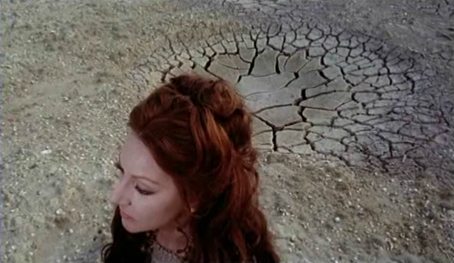
There is still an abundance of extraordinary imagery (this time provided by ace cinematographer Ennio Guarnieri, working with Turkish locations), and the audio assault of esoteric African and Balkan folk music is impressive and distinctive.  Medea is too exotic to be truly dull, but Pasolini’s take on the material is tediously repetitive, awkwardly structured, and dramatically inert.  Jason (Giuseppe Gentile) is initially presented as the film’s protagonist, before the perspective abruptly shifts to Medea (opera legend Maria Callas, acquitting herself nicely in her only film role ).  Jason’s betrayal of Medea, which sets most of the actual plot in motion, happens late in the film and mostly offscreen, which makes it hard to have any sort of reaction to her violent revenge on Jason’s family.  That revenge is also inexplicably presented in two successive, barely distinguishable versions to no discernible dramatic effect.  A few of Pasolini’s films up to this point have been problematic for one reason or another, but Medea is the first one that finds the director repeating himself.

UP NEXT  Teorema and Porcile